


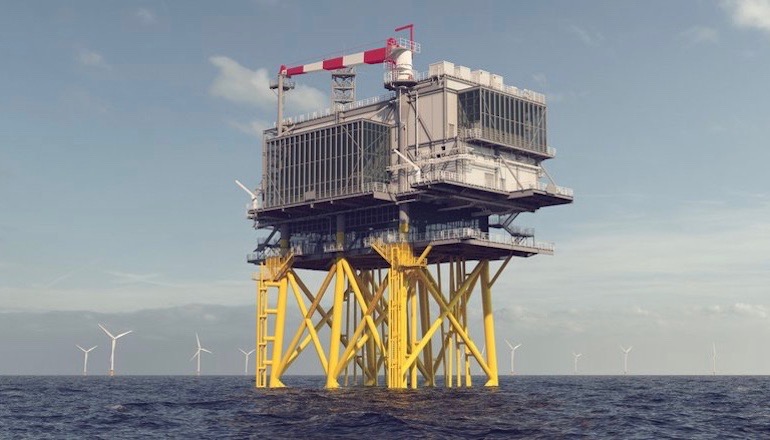
Transmission system operator TenneT has struck agreements with Orsted and EnBW to directly connect several future offshore wind farms in Germany to converter stations rather than via an offshore substation.
The agreements cover Orsted’s Borkum Riffgrund West 1 and 2 and Northern Energy OWP West offshore wind farms and EnBW’s He Dreiht project should be connected straight to converter platforms with 66kV cabling, instead of using 155kV wires and an offshore substation.
“As a result, the construction of offshore substations by the wind farm constructor can be avoided or reduced to the lower requirement of an offshore service platform. In addition, the export cable for the network operator is omitted,” TenneT said.
The Orsted wind farms are expected online in 2024, with He Dreiht scheduled for 2025, connected to TenneT’s converter platforms DolWin epsilon and BorWin epsilon, the TSO said.
TenneT managing director Tim Meyerjurgens said: “This connection concept leads to an enormous cost reduction in the wind farms and for the grid connection.
“With the 66kV direct connection, we have developed a new generation of cost-efficient offshore grid connections for the German North Sea, which will make an important contribution to the energy transition.”
EnBW head of portfolio development for offshore wind Holger Grubel said: “A direct connection offers advantages for all those involved, especially since EnBW He Dreiht utilises the entire capacity of the converter.
“At the same time, however, this new approach requires close coordination between stakeholders in all phases of the project in order to meet the technical challenges.
“Open exchange is important in order to come up with meaningful solutions and manage the operational risks. The expected benefits and reduced environmental impact help on the way to a wide acceptance and ultimately relieve the consumer.”
TenneT said the German Federal Maritime and Hydrographic Agency will use the connection concept in the context of separate approval procedures for grid connections for offshore wind farms.
It said initial discussions with the agency have already been held, adding that the direct connection concept will be a standard alternative as of 2026, provided the distance between the wind turbines and the converter platform permits.