


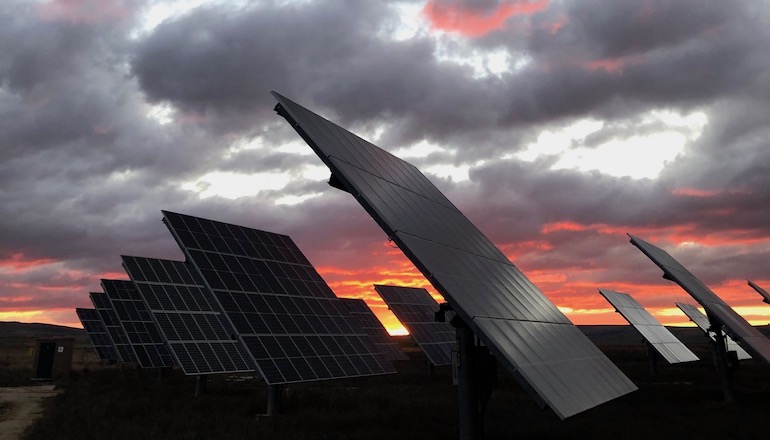
Acciona has established an innovation hub at its 246MW El Romero solar farm in the Atacama region of Chile to test new technologies that aim to improve the efficiency and performance of photovoltaic energy facilities.
The Spanish company said the hub will focus on the mechanical and energy capacity of double-sided crystalline, split-cell and thin-film cadmium telluride technologies, all of which are in the development phase.
Solar modules have been produced by JA Solar and First Solar, while a variety of solar trackers will be used, manufactured by STI Nordland and Soltec.
The hub will have a total capacity of 492kW consisting of 1280 modules on three series of trackers connected to nine inverters.
Acciona said other equipment will be used to measure and monitor parameters, such as incident and reflected solar radiation, ambient temperature or the production temperature of each kind of module.
It said that, unlike conventional solar modules, which only have photovoltaic cells on one side, double-sided modules have cells on both sides of the panel to capture reflected solar radiation and increase output per surface unit occupied.
Split-cell modules are divided into two parts to reduce energy losses and improve the durability of the panel, the company said.
Thin-film modules are made from semi-conductive materials as alternatives to conventional crystalline silicon – such as cadmium telluride – to reduce both manufacturing costs and the carbon footprint, Acciona added.
Acciona energy division innovation director Belen Linares said: “Our innovation activity is mainly aimed at improving the performance and work life of our renewable plants.
“The results obtained at El Romero hub are going to be very useful in order to build increasingly efficient photovoltaic installations at a lower cost.”