


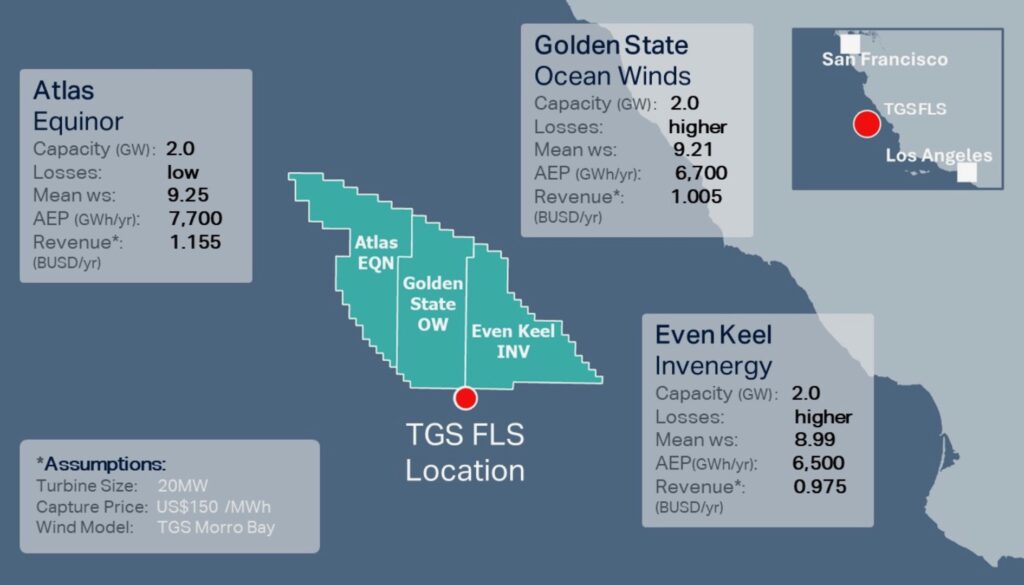
Energy data and intelligence provider TGS has announced a new campaign for offshore wind and metocean measurements in Morro Bay, off the US west coast.
The campaign seeks to greatly enhance the industry’s understanding of offshore conditions across three wind energy lease areas in Morro Bay, California by calibrating TGS proprietary wind models with observational data.
The three-year deployment in an area with an average depth of 1000 metres will be the first by TGS on the US West Coast and will add to its comprehensive library of wind and metocean data collected on the US East Coast, Norway and Germany.
The data will offer crucial insights throughout the floating wind farm development lifecycle.
This includes environmental impact assessments and technical decisions such as turbine selection, layout optimization, foundation design, and operations and maintenance planning.
Additionally, it will enable more accurate modeling of capital expenditures, operational expenditures, potential energy production and grid requirements.
High-quality ocean current measurements and tidal information collected over this period will be valuable for grid connection planning, while accurate atmospheric turbulence intensity observations will provide key inputs for wind farm energy yield.
Supplied by EOLOS, the buoy is equipped with advanced sensors designed to capture detailed measurements of wind, metocean, and environmental data.
Key metrics include wind speed and direction at turbine hub height, wave heights, ocean current data across the full water column, and monitoring of birds, bats and fish.
Data will be continuously streamed, quality-controlled, and made available daily to customers via Wind AXIOM, TGS’ state-of-the-art site evaluation and wind data analytics platform.
Wind AXIOM enables wind developers and stakeholders to improve the quality and speed of their decision-making processes by identifying the most critical factors affecting the viability of offshore wind projects, TGS said.
The company’s chief executive Kristian Johansen said: “TGS remains committed to supporting the growth of the global offshore wind industry.
“We are excited to bring our solutions to California, where floating wind technology is gaining momentum.
“With our multi-client floating LiDAR campaign, we make high-quality wind and metocean data more accessible, enhancing investment and planning decisions and contributing to the success of US offshore wind development.
“This ninth LiDAR deployment within the last two years demonstrates our commitment and the multi-client model’s continued value to the offshore wind industry.
“It provides superior data earlier to developers worldwide, helping them reduce risk throughout the project lifecycle.”
This deployment is supported by funding from the offshore wind industry and is expected to be launched in third quarter 2024.