


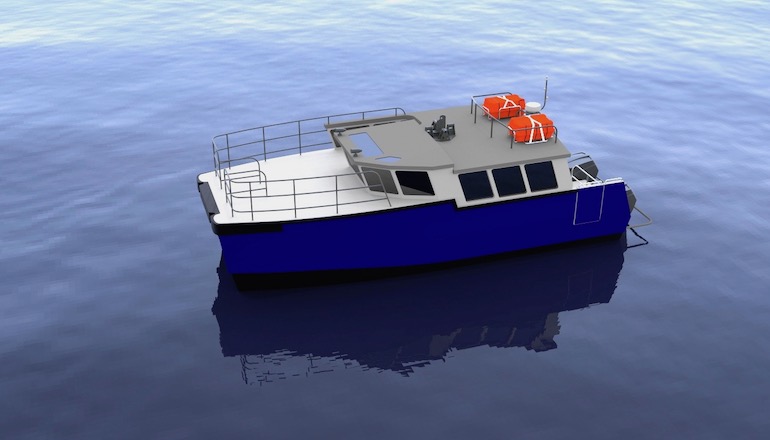
Naval architect Chartwell Marine and technical consultancy Seaspeed Marine Consulting have been awarded a prize by the Carbon Trust’s Offshore Wind Accelerator (OWA) for an innovative vessel design proposal.
The OWA competition aims to facilitate the development of technologies aiding the ongoing de-carbonisation of crew transfer vessels (CTVs) in the offshore wind industry.
The funding – £70,000 – will be used to make the design proposal a reality.
During the project, Chartwell will undertake the vessel design work, while Seaspeed will carry out research and development, testing and hull form development.
The work programme will run to May 2020, during which time the design will be modelled, designed, tested and commercialised by Chartwell.
Chartwell Marine managing director Andy Page said: “The scope of the competition was broad, which gave us the flexibility to explore new avenues in vessel design.
“We agree strongly with the Carbon Trust and OWA partners that sustainability should be a focus for support vessels in offshore wind – and this goes hand in hand with increased efficiencies across the board.
“At Chartwell, we have a strong track record in pioneering vessel designs that not only are ready for new hybrid technologies, but are also specified from the outset with efficiency in mind, helping low carbon industries like offshore wind increase their cost competitiveness.”
Carbon Trust offshore wind manager Dan Kyle Spearman said: “We are looking forward to supporting the development of the four winning technologies, which have the potential to reduce emissions and fuel consumption in the offshore wind industry.
“SMEs, like Chartwell Marine and Seaspeed, have an important role to play in driving innovation, bringing their products and skills to support the cost reduction and scaling of offshore wind.”
Seaspeed Marine Consulting managing director Stephen Phillips said: “The maritime industry as a whole has come a long way in reducing emissions.
Other successful companies receiving OWA funding from a total pot of £300,000 were CWind, Robert Allan and Windcat Workboats and CMB Technologies.
CWind is supporting technology development for the construction of a prototype hybrid diesel/electric surface effect ship CTV.
Robert Allan will carry out a desktop study for a methanol/electric hybrid CTV.
Windcat Workboats and CMB Technologies are supporting the development of a prototype hydrogen powered CTV which uses hydrogen-diesel co-combustion.