


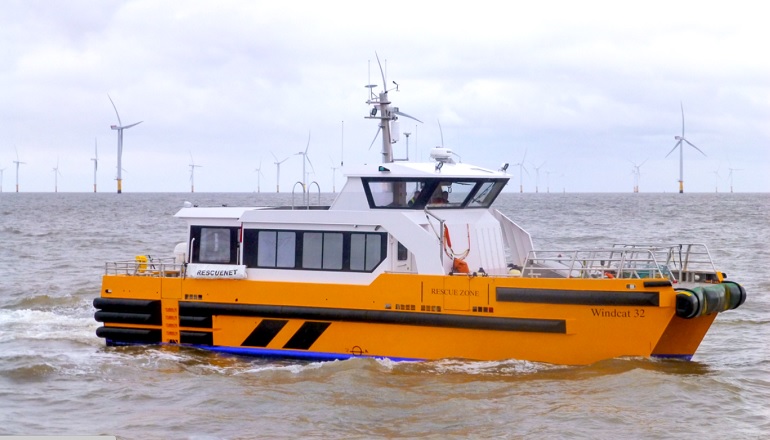
Several offshore renewable energy and marine companies are taking part in a project to explore the viability of offshore vessel charging as part of the industry’s efforts to decarbonise vessel operations.
The first phase of the UK Government’s Sustainable Innovation Fund is funding the project led by Turbulent Simulations.
Other partners are Aluminium Marine Consultants, the Offshore Renewable Energy (ORE) Catapult, MJR Power & Automation, Tidal Transit and Bibby Marine Services.
The participants will explore the design of a permanently stationed offshore charging vessel.
The technology would allow electrified vessels, such as crew transfer vessels (CTVs) and service operation vessels (SOVs), to dock and recharge whilst operating offshore, giving them greater range and bigger operating windows.
The charging vessel would, in turn, draw power from wind farms at times of low demand, storing it in onboard batteries.
ORE Catapult is undertaking a market awareness study for the project to gain insights from vessel designers, vessel operators and wind farm owner operators that will inform how industry standardisation for the connection between vessel and charging system can be achieved.
Having a charging capability offshore is expected to bolster owner/operator confidence to invest in electrified vessels, as the offshore infrastructure will have greater flexibility to operate in the field for longer periods, enabling reduced operations and maintenance costs.
The project partners will also explore the potential for the charging vessel to store modular battery units that could be swapped for the used battery on the operating vessel.
The project has already attracted significant interest, with confirmed backing from industry advisers, including Vattenfall Networks, Vattenfall Renewables and the Workboat Association (WA).
The consortium is also hoping to advance to the second phase of the Sustainable Innovation Fund, potentially accessing £3m of grant funding to undertake a detailed design and demonstration of the charging vessel.
Turbulent Simulations CEO Trevor Linn said: “We have more than six years of experience working on software coding and digital solutions for clients including the Ministry of Defence and Lockheed Martin.
“We’re excited to be working with leading offshore wind industry partners and bring our knowledge and experience of software and digital integration to bear in tackling the challenge of offshore charging.
“We see huge potential and strong market demand for this innovative technology as the offshore wind industry and the broader maritime sector seek solutions for charging the next generation of electric and hybrid service vessels.”