


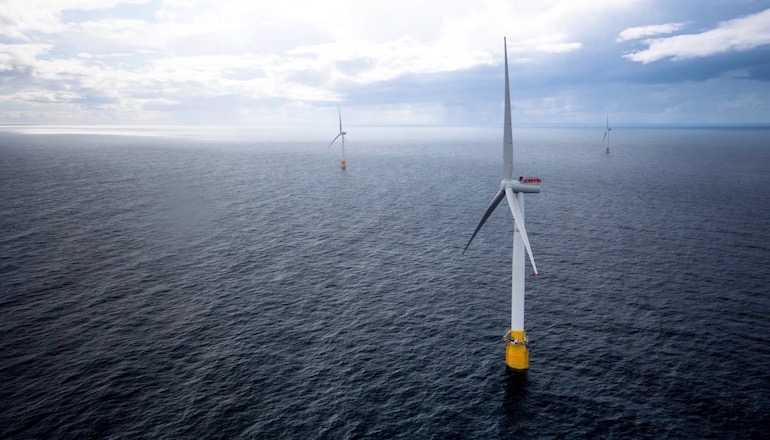
Additional government support and continued trade links with Europe are needed to ensure the UK maintains its lead in deploying floating wind, a new report has advised.
The University of Strathclyde’s ‘Offshore wind, ready to float? Global and UK trends in the floating offshore wind market’ study reviewed 60 floating wind projects worldwide and has made five key recommendations to support the market’s growth.
It advises the government to introduce a new long-term subsidy for floating wind projects that offers a guaranteed level of subsidy, over a specified number of years.
“A new ‘innovation-oriented’ Contracts for Difference pot for pre-commercial technologies would create such a resource,” said the report.
Secondly, the UK and devolved governments should move to retain access to EU demonstration funding post-Brexit, according to the report.
“If unsuccessful, their own funds must cover any shortfall, with a focus on demonstration grants and government-backed finance,” it stated.
The document recommends that Brexit impacts on cost and delivery timelines of floating wind projects, as well as the financial performance of UK offshore wind companies, need to be assessed.
The report said, “Consideration should be given to what trading arrangements will support the future growth of floating wind in the UK and Europe more widely.”
The report advises a study to identify potential niche markets for floating wind, alongside associated cost benefits and barriers to deployment, should be funded which would “inform policy design to support expansion of commercial floating wind”.
Finally, the report recommends support should be given to the UK to “grow its domestic content of the floating wind supply chain by helping firms already operating in the wind sector, or other sectors with synergistic capabilities, to transition into it”.
The report research was undertaken by researchers at the University of Strathclyde’s Business School and School of Electronic and Electrical Engineering, in partnership with DNV GL, the Wind and Marine Energy Systems CDT and SuperGen Wind.
University of Strathclyde director of research at the Hunter Centre for Entrepreneurship Matthew Hannon, who led the research, said: “There is roughly 10 times the capacity of offshore wind deployed in UK waters today compared to a decade ago.
“However, for the UK to meet its highly ambitious 2050 net-zero carbon target, it is essential its offshore wind sector continues to expand over the next 30 years.
“The issue is that our current inability to generate wind power cost-effectively from deep waters presents a potential bottleneck to the future expansion of UK offshore wind, especially the deep waters surrounding Scotland.
“Floating wind technology presents the key to removing this constraint, by unlocking an untapped wind resource from deeper, more remote waters.”
Scottish Renewables chief executive Claire Mack said: “This new research correctly identifies that there is a very significant opportunity for floating offshore wind technology development here in Scotland, and indeed in the rest of the UK.
“Scotland’s deeper waters mean floating wind represents a natural evolution of this country’s current success in fixed offshore projects.
“There are challenges in moving any technology to a large-scale commercial footing, but the size of the global prize means investments made today in skills, infrastructure and supply chain development to support the floating offshore market could pay huge dividends in future.”