


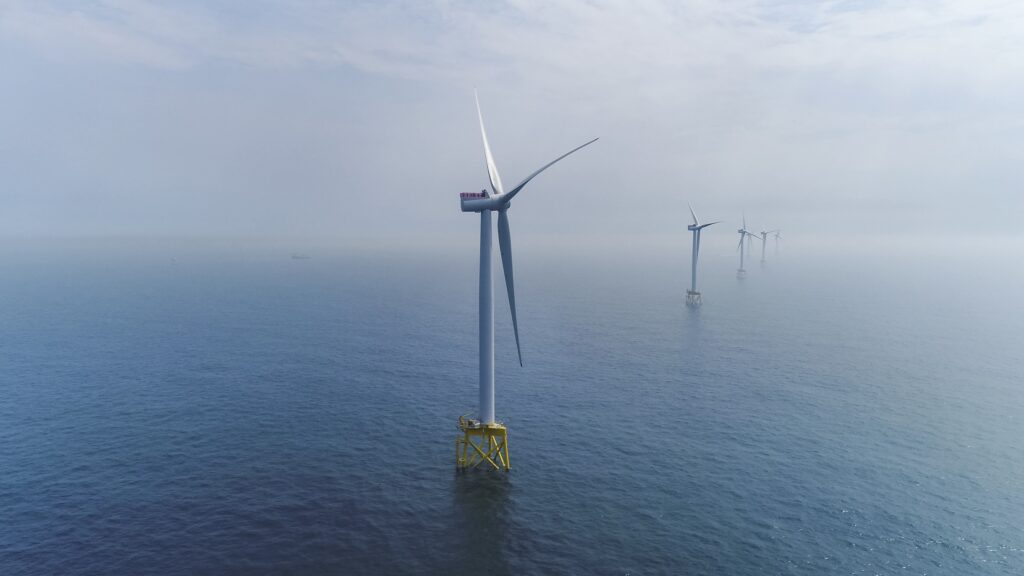
The latest round of offshore wind farms to be built in the UK could reduce household energy bills by producing electricity cheaply enough, according to researchers at Imperial College London.
The most recently approved offshore wind projects will most likely operate with “negative subsidies” – paying money back to the government from the middle of this decade, the researchers found.
The researchers analysed similar offshore wind auctions held by governments of five European countries.
They found that Germany and the Netherlands have seen some zero-subsidy offshore wind farms winning auctions, but that the UK projects are likely to be the world’s first negative-subsidy offshore wind farms.
The money will go towards reducing household energy bills as the offshore wind farms start producing power in the mid-2020s, said Imperial College London in a study paper.
To date renewable energy projects, including onshore and offshore wind and solar farms, have mainly been subsidised by government support schemes, which has led to concerns these projects are pushing up electricity bills.
Lead researcher Malte Jansen, from Imperial’s Centre for Environmental Policy, said: “Offshore wind power will soon be so cheap to produce that it will undercut fossil-fuelled power stations and may be the cheapest form of energy for the UK.
“Energy subsidies used to push up energy bills, but within a few years cheap renewable energy will see them brought down for the first time. This is an astonishing development.”
The analysis of five countries in Europe, including the UK, focused on a series of government auctions for offshore wind farms between February 2015 and September 2019.
Companies that want to build wind farms bid in the auctions by stating the price at which they will sell the energy they produce to the government.
These are known as Contracts for Difference (CfDs).
If a company’s bid is higher than the wholesale electricity price on the UK market once the wind farm is up and running, then the company will receive a subsidy from the government to top up the price.
However, if the stated price is less than the wholesale price, then the company will pay the government back the difference.
This payback is then passed through to consumer’s energy bills, reducing the amount that homes and businesses will pay for electricity.
The UK’s September 2019 auction made the headlines as winning companies said they could build new offshore wind farms for around £40 (€43) per megawatt hour of power. This was a new record set by these wind farms with bids 30% lower than two years earlier.
The Imperial team analysed likely future electricity price trends and found that contracted price is very likely to be below the UK wholesale price over the lifetime that these wind farms would produce electricity, from the mid-2020s onwards.
The team found that these wind farms are likely to be built and run with these costs, since financing is now accessible at lower costs for such projects, owing to trust in the now mature technology.