


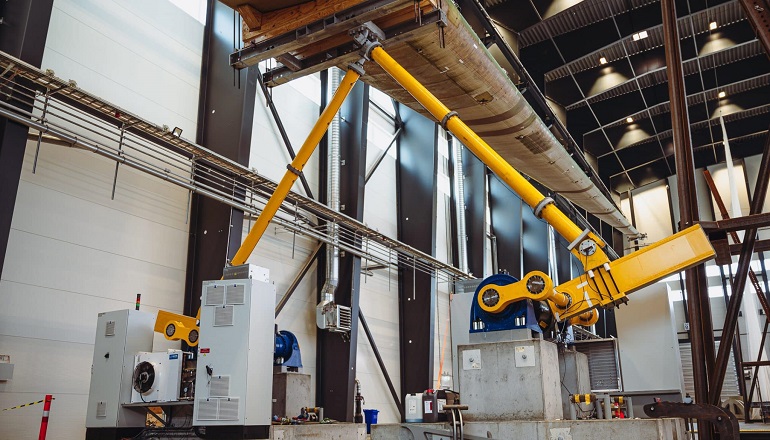
Vestas has commissioned testing equipment in Denmark to carry out extreme voltage tests to ensure its offshore wind turbines meet international grid connection standards.
Danish offshore wind turbine test expert R&D Test Systems has installed the world’s first fault ride through (FRT) test system rated at 66 kV at the National Test Centre for Large Wind Turbines operated by the Danish Technical University (DTU) facility, Osterild.
R&D Test Systems designed the new system to meet Vestas’ specific testing requirements following the installation of a large prototype turbine at Osterild.
Bigger turbines have associated increases in power output, resulting in wind farms using ever higher voltages to achieve efficient power transmission through the long cables required to bring the power generated ashore.
The new R&D FRT test system now allows turbines to be tested directly at the operating voltage of 66 kV, avoiding any set-down transformer converting the test setup to 33 kV.
“The 66 kV output voltage rated test equipment that was needed was not available on the market. We applied our engineering expertise in large-scale wind turbine tests for the onshore and offshore drive trains and the requirements for grid compliance this new FRT test rig,” said Sascha Heinecke, sales director at R&D Test Systems.
“We believe the FRT Test equipment at these high voltages will become standard in the future.
“As offshore wind turbines will play a significant role in the supply of electricity, testing at extreme voltages will become crucial in proving that a wind turbine type will connect to the electric grid without any hitches. Proving grid compliance is pivotal,” added Heinecke.
The point of FRT testing is to prove that wind turbines are resilient to grid power quality issues such as when power transmission cables are damaged in a storm.
The test is designed to ensure that the generating units, increasingly located out at sea, do not fail due to voltage variations in the power transmission network – a scenario that could lead to costly downtime, maintenance and, in extreme situations, power outages.
“The test system can simulate power interruptions as well as over- and under-voltage in the transmission network to monitor how the wind turbine reacts
ese test systems will increase in the future as offshore wind capacity increases and grid compliance tests at high voltages are required,” added Heinecke.
Delivering the 66 kV FRT test system took over 12 months and employed a multidisciplinary team of electrical, software, and mechanical engineers with specialist skills in wind turbine testing.