


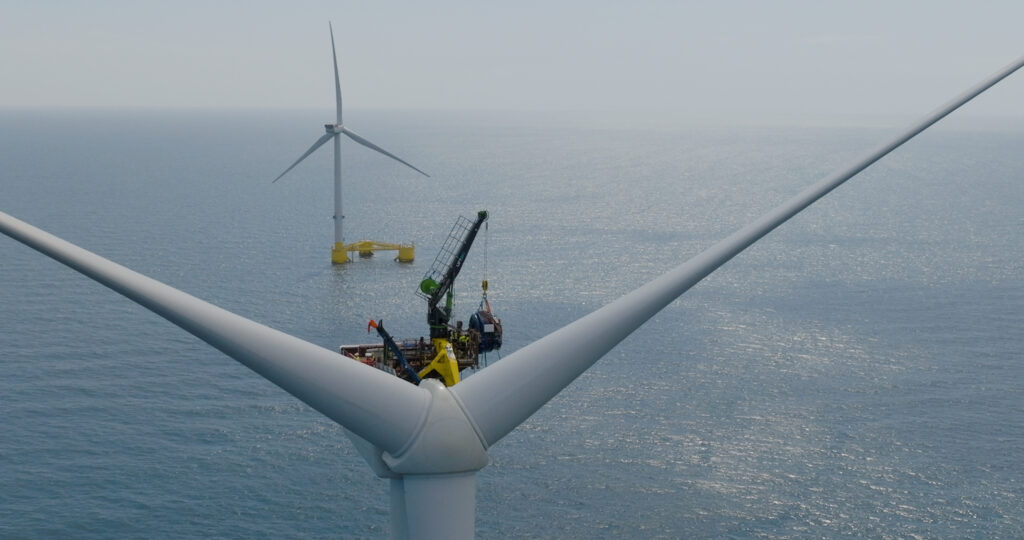
A generator swap on a turbine at the 50MW Kincardine floater off east Scotland has been completed in what is claimed to be the world’s first major component exchange conducted in-situ at a floating wind farm.
The work on a Vestas V164-9.5MW turbine was delivered using an offshore support vessel without the need to tow the unit to a port.
To perform the process an up-tower crane, supplied by LiftOff, was temporarily installed atop the Vestas machine to lift the old generator from the nacelle and lower it on to the deck of the floater, for transfer to the OSV.
The replacement generator was then transferred to the floater and lifted into the nacelle using the same methodology.
During the operation, load-control mechanisms were installed for the lifting activities with real-time motion monitoring.
The project was completed in less than a month including full mobilisation and demobilisation of equipment.
Dragados Project Manager and General Manager at Kincardine José Polimón Olabarrieta said: “By pushing the boundaries of innovation and embracing the requirement to improve previous processes, we have achieved a world-first technical solution that redefines the future for the renewables industry.
“In Dragados we are delighted to have produced a solution that can be implemented on-site, which will negate the requirement to disconnect and tow the turbine ashore for repair.”
Thore Abel, Director, Global Service Contracting, at Vestas said: “Tow-to-port operations for major component exchanges have been a key challenge in the floating wind space for years.
“This innovative in-situ solution, using an up-tower crane on a geared Vestas turbine, showcases that alternative means to towing activities are no longer just possible on paper or in animations, but a proven solution.
“This can pave the way to viable improvements in feasibility of floating wind projects around the world and should encourage the industry to continue its innovative approach.”