


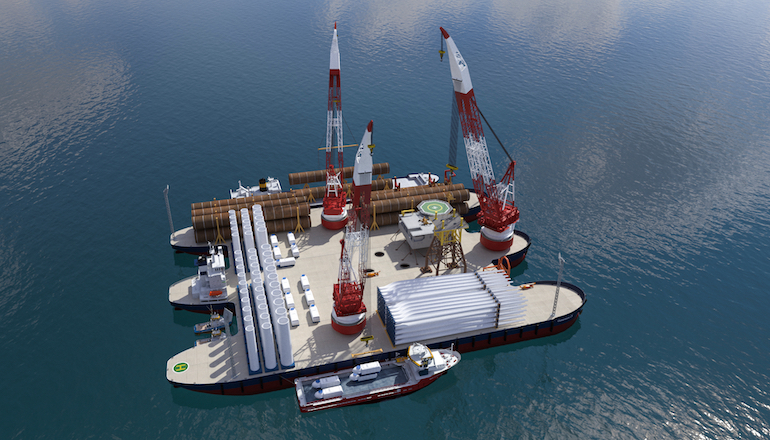
Australia’s National Ports Corporation subsidiary Windthrust has unveiled plans for a combined self-propelled offshore wind floating port and installation vessel for foundations, turbines and substations.
The Oceandock LX vessel would have a 60,000 metre-squared deck area, a 700,000 square metre under-deck, two 2600-tonne cranes and one 6000-tonne crane capable of lifting a substation in one single lift, Windthrust said.
The company said it has been working closely with offshore wind market leaders from Northern Europe to identify the key factors and requirements for a more cost effective, faster and lower risk deployment of the next generation of wind farms.
National Ports managing director Marco Lucido said: “The next generation of wind turbines will be larger and heavier in order to keep up with the rapid increase in global demand for renewables.
“This will require far larger vessels that can offer heavier lifting capacity and increased deck space.
“Today’s installation vessels are not fit for purpose, as they simply do not have the capacity to meet the requirements.”
He added that currently, it can take four or more vessels to install the different components of a wind farm.
Oceandock’s massive deck space and onboard storage facility allows for the components to be delivered directly to the vessel and warehoused, he said.
Lucido said: “Furthermore, the cranes will have the lifting capacity and reach for their installation.
“Offshore wind farm development will surge on a global scale in the coming years with approximately 24 farms expected within US waters alone.
“With this surge, port capacity and accessibility to service these developments are at risk. In our case, the Oceandock LX’s onboard storage facility is an ideal solution.”