


To achieve the European Commission’s target of 450GW of offshore wind by 2050 requires annual installation rates to rise from 3GW today to over 20GW in 2030, according to a report from WindEurope.
‘Our energy, our future’, published at Offshore 2019, concludes that Europe’s “big goals” for offshore wind – between 230GW and 450GW by 2050 – are achievable, provided the “right investments” occur in electricity grids and governments take the “right approach” to maritime spatial planning.
In other key findings, the study suggests that the bulk – 212GW – should be deployed in the North Sea, followed by 85GW in the Atlantic, which includes the Irish Sea, 83GW in the Baltic, and 70GW in the Mediterranean and other southern European waters.
According to the report the distribution “reflects the relative wind resources, proximity to energy demand and the location of the supply chain.”
The report also breaks down how would each country would deploy in an optimal scenario. The 380GW that would deployed in Northern European waters would require less than 3% of the total space of the sea in that region.
‘Our energy, our future’ is a remit from the energy ministers of the 10 ‘North Seas’ countries who coordinate their work on offshore wind with each other and the European Commission.
The report examines where 450GW of offshore wind could be deployed most cost-effectively around Europe, from 20GW today. The 450GW of capacity is part of a European Commission scenario to deliver climate neutrality by 2050.
The study also considers how much it would cost to build large volumes of offshore wind, showing how maritime spatial planning is key to minimise costs.
In at least 60% of the North Sea it is not possible to build offshore wind farms today.
These ‘exclusion zones’ exist either for environmental reasons or because space is set aside for fishing, shipping and military activity.
The report states, “They mean we can only build less than a quarter of the required volumes at very low cost – below €50/MWh.
“But with a different approach to maritime spatial planning, with climate change at its heart, we could build much more at these prices – and benefit fully from the spectacular cost reductions achieved in recent years.”
The study advises that “multiple use”, for example, allowing certain types of fishing in offshore wind farms, would really help.
The report says governments should also “anticipate this significant growth” in offshore wind in their planning for both offshore and onshore grid connections. Offshore grid investments will need to rise from less than €2bn in 2020 to up €8bn a year by 2030.
“Europe also needs to provide a regulatory framework for offshore wind farms that have grid connections to more than one country. These ‘hybrid’ projects will enable us to pool assets and infrastructure and reduce costs,” stated the study.
Capital expenditure on offshore wind including grids will need to rise from around €6bn a year in 2020 to €23bn by 2030 and thereafter up to €45bn.
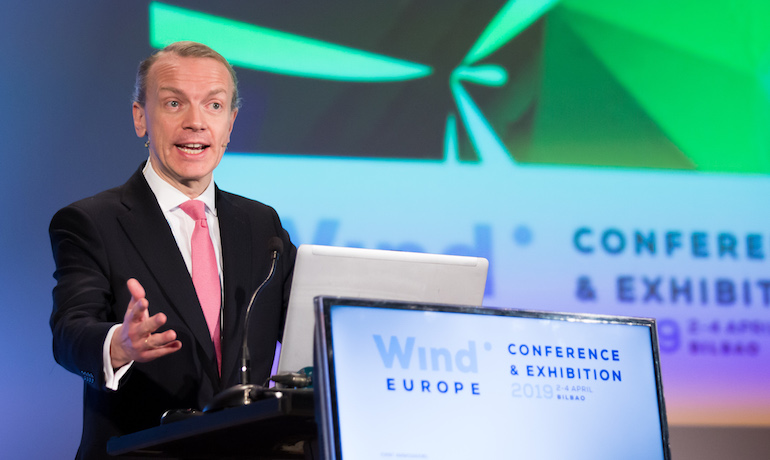
WindEurope chief executive Giles Dickson said: “The EU says Europe needs at least 10 times as much offshore wind as we have today meet the 2050 goal of decarbonising energy. The International Energy Agency believes offshore wind could become the number one source of power generation in Europe in the early 2040s.
“The report shows that it is do-able and affordable. But three things need to happen: the offshore wind supply chain keeps growing; we build the grid connections; and we get the maritime spatial planning right.”