


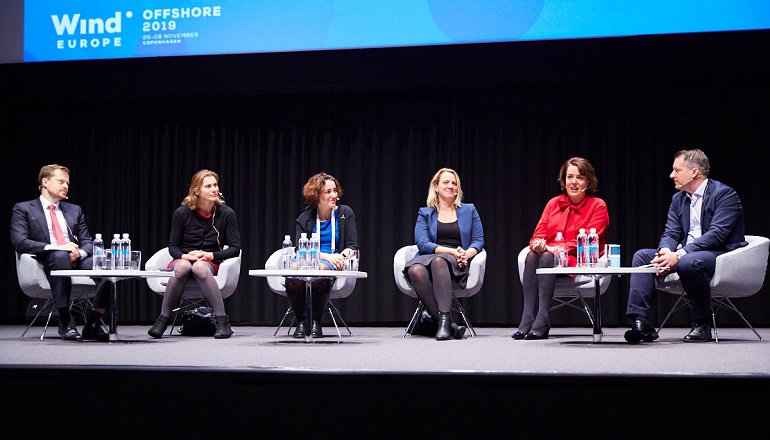
Grid investment needs a high degree of coordination across different EU markets to achieve the 450MW by 2050 offshore wind target, according to a panel of experts at WindEurope’s Offshore 2019 event.
TenneT chief executive Manon van Beek and Vattenfall’s Catrin Jung agreed that building out the offshore grid will be vital if Europe is to reach 450GW of offshore wind by 2050, but developing onshore grids is key to achieving the ambition.
“If we do not look at both we could slow down the rate of offshore growth. This will require a collaborative approach,” van Beek said.
The need for a collaborative approach was echoed by Marie Hindhede from the Danish Ministry of Energy, Utilities and Climate.
Denmark has already integrated a high share of renewables and is now looking at a 10GW energy island hybrid project. This will ramp up scale and drive down costs even further, but will require collaboration with neighbouring countries.
Hindhede and Jung both pointed to collaborative work between North Sea countries on offshore wind in attempting to harmonise and standardise national rules as a best practice example that could be deployed in other parts of Europe as offshore wind expands.
Jung said: “Kriegers Flak is the only current example of a hybrid project, but in this case the transmission system operators are in the driving seat of developing the interconnection.
“As a developer, if we don’t get clear regulation that allows for a common project with joint procurement between the two countries, it will never happen.”
The panel agreed on the need for policymakers to issue clear signals on grid development plans and maritime spatial planning to provide certainty.
The European Commission’s acting head of unit networks and regional initiatives, Jane Amilhat, pointed to the commission’s long-term approach with grid operators to identify network expansion and investment needs.
Expanding grids onshore to cope with a massive expansion of offshore wind capacity will also mean efforts to ensure local acceptance, said Hindhede, pointing to the need to explain the necessity of electricity grids to the public – starting with schools – in dealing with climate change.