


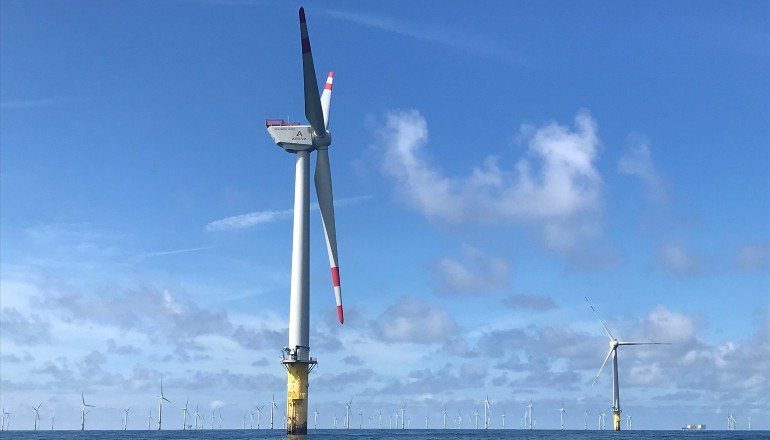
Deutsche Windtechnik has successfully performed maintenance work on the Adwen turbines at Germany’s Alpha Ventus Offshore Wind Farm.
Since taking over maintenance responsibilities for the six wind turbines at the start of 2020, the company has increased their technical availability from 42% to 77% in the 2020/21 period.
While the low initial score was mainly due to a previous turbine crash and longer downtimes, the technical availability has risen in 2022, currently sitting at 94%.
The was due to a consistently high proportion of remote fault elimination of about 50%, along with a range of measures designed to gradually optimise turbine operation.
In particular, the company began planning maintenance and service operations early and more transparently, as well as consolidated various service teams and competencies to halve the number of days for maintenance work – from eight to ten in 2020 to four to five in 2022.
In addition, the company revised the safety concept and expanded the stock of spare parts.
These measures were developed and implemented in close cooperation with the operator DOTI (Deutsche Offshore-Testfeld und Infrastruktur) and the operations manager Omexom Renewable Energies Offshore.
The Alpha Ventus Offshore Wind Farm has a 60-MW nameplate capacity. Situated in the North Sea off the cost of Germany, it was the country’s first offshore wind farm, commissioned in 2009.
Deutsche Windtechnik provides the Alpha Ventus Offshore Wind Farm with remote data monitoring, troubleshooting, scheduled maintenance for the turbines, maintenance of the systems, technical support and the storage of spare parts.
The company trains its technicians for the deployments itself to ensure high quality of service for Adwen turbines.
Managing director of Deutsche Windtechnik’s offshore unit Jens Landwehr said: “Together with DOTI and Omexon, we analysed, evaluated and prioritised the operating errors at the beginning of the contract and developed suitable solutions.”
“The step-by-step implementation of the measures, the improved operational planning and logistics as well as the excellent teamwork between our internal and field service enabled us to permanently correct the errors, and this is reflected in the high availability.
“The important thing now is to keep going and implement further optimisations, for example in the area of spare parts management and by eliminating further redundancies and developing more retrofits that increase availability.
“The turbines can clearly make an economic contribution to the energy transition, even though they were built in 2010.”