Close Menu
reNEWSreNEWS
  • Home
  • Offshore Wind
  • Onshore Wind
  • Solar
  • Other News
    • Energy Storage
    • Finance
    • Grid
    • People
    • reMIX
  • More
    • Company Profiles
    • Events
    • National Wind Energy Awards 2026
Latest News

PODCAST: Is UK offshore wind back on track?

All-Energy 2026: Shanks bullish on UK clean power

GWEC, TÜREB launch wind partnership

LinkedIn Facebook X (Twitter)
  • Email Briefings
  • About
  • Advertise
  • Contact
reNEWSreNEWS
  • Home
  • Offshore Wind

    PODCAST: Is UK offshore wind back on track?

    May 13, 2026

    UK offshore wind pipeline reaches 93GW

    May 13, 2026

    Seaway7 completes Hai Long cable works

    May 13, 2026

    DEME names new jack-up vessel

    May 13, 2026

    Mubadala invests $325m into Hornsea 3

    May 13, 2026
  • Onshore Wind

    ENERCON to build Türkiye blade plant

    May 13, 2026

    ‘Fatality at South Korean wind farm’

    May 13, 2026

    Scottish onshore wind forum launches

    May 12, 2026

    ENOVA starts 30MW Hiddels repowering

    May 12, 2026

    Iberdrola buys 40MW Italian wind farm

    May 12, 2026
  • Solar

    VSB secures Sicily PV project approval

    May 13, 2026

    Matrix connects two Spanish renewable projects

    May 13, 2026

    Qualitas targets €10bn energy investments

    May 12, 2026

    Consultation opens for 49.9MW Barrons Solar

    May 12, 2026

    Great North Road solar nears decision

    May 11, 2026
  • Other News
    • Energy Storage
    • Finance
    • Grid
    • People
    • reMIX
  • More
    • Company Profiles
    • Events
    • National Wind Energy Awards 2026
LinkedIn Facebook X (Twitter)
reNEWSreNEWS
Home»Onshore Wind
Onshore Wind

Blades could have smart future

German researchers have examined new rotors that adapt to the wind
EBSBy EBSFebruary 8, 20163 Mins Read
Share LinkedIn Facebook Twitter Bluesky Reddit Copy Link Email
Blades could have smart future

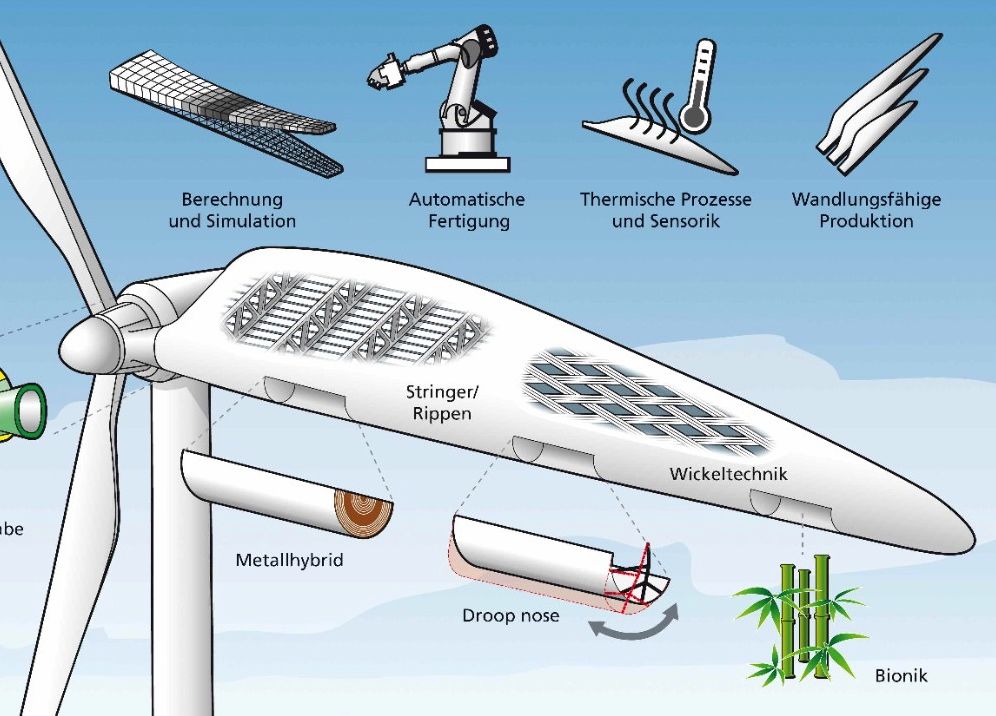
German researchers have examined new concepts for so-called ‘smart’ rotor blades that can adapt to the wind.

The three-year €12m Smart Blades project was funded by the German Federal Ministry for Economic Affairs and Energy.

It has examined blades that are able to adapt their geometry to suit the local wind conditions using active and passive technologies.

The project was a joint effort between Research Alliance Wind Energy (FVWE) the German Aerospace Center (DLR), Fraunhofer IWES and ForWind, the Center for Wind Energy Research of the Universities of Oldenburg, Hanover and Bremen.

“The findings of this project offer turbine developers and operators new information and tools allowing them to launch more effective, more cost-efficient and more reliable system designs on the market,” the researchers said.

They added that when a rotor blade is subject to high wind it turns in such a way that it offers the wind a smaller contact surface, known as bending-torsion coupling.

The bending is initiated by the force of the wind alone and is described as a ‘passive’ mechanism.

The research focused on two approaches that produce this effect. On the one hand, a crescent-shaped geometry was examined and, on the other, a particular structure was employed for the material composition of the rotor blade.

Fraunhofer IWES smart blades technology coordinator Alper Sevinc said: “The advantages of the mechanisms are that the blades can be built with a less robust design and are therefore lighter.

“Both processes have the potential to improve the energy utilization of wind power systems.”

The researchers now hope to be able to investigate the mechanisms tested in the simulation on demonstration rotor blades they have already designed in a future project.

The researchers also looked at active mechanisms that adapt the trailing edges of a rotor blade and which system operators can use to control the aerodynamic loads on a rotor blade.

They said the concept was inspired by the aviation industry and is comparable to the flaps on the wings of aircraft.

The researchers also considered whether a flexible leading edge flap on a rotor blade can improve the efficiency of wind turbines subject to heavily fluctuating, turbulent wind conditions.

The new approaches were test for cost-efficiency with a state-of-the-art 80-metre-long rotor blade in simulations.

The next step would be for the researchers to be able to test their results on full-scale rotor blades.

Image: some of the smart blade concepts (Fraunhofer IWES)


Europe Germany Onshore Wind

Related Stories

‘New wind radar enables ultra-fast measurements’

June 23, 2025

German researchers aim to improve blade recycling

April 6, 2022

Smart blades given US outing

December 10, 2018
Advertisement

Latest News

PODCAST: Is UK offshore wind back on track?

May 13, 2026

All-Energy 2026: Shanks bullish on UK clean power

May 13, 2026

GWEC, TÜREB launch wind partnership

May 13, 2026

ENERCON to build Türkiye blade plant

May 13, 2026
Advertisement

Advertisement

Company Profiles
  • Collett & Sons Ltd
  • TGS
  • Qualsurv Marine Consulting
    Qualsurv Marine Consulting
  • Ørsted
  • Oceantic Network
  • Natural Power
    Natural Power
  • LSP
    LSP Renewables
  • JDR Cable Systems Ltd
  • EDF
    EDF
  • Brightwind
    BrightWind Limited
reNEWS
LinkedIn Facebook X (Twitter)
reMIX | Company Profiles | Industry Events
Get in touch | Advertising with us | About reNEWS

© 2026 Lewis Business Media. All Rights Reserved.
Lewis Business Media, Suite A, Arun House, Office Village, River Way, Uckfield, TN22 1SL

Terms and Conditions | Privacy Policy | Cookie Policy

Type above and press Enter to search. Press Esc to cancel.

Manage Consent
To provide the best experiences, we use technologies like cookies to store and/or access device information. Consenting to these technologies will allow us to process data such as browsing behaviour or unique IDs on this site. Not consenting or withdrawing consent, may adversely affect certain features and functions.
Functional Always active
The technical storage or access is strictly necessary for the legitimate purpose of enabling the use of a specific service explicitly requested by the subscriber or user, or for the sole purpose of carrying out the transmission of a communication over an electronic communications network.
Preferences
The technical storage or access is necessary for the legitimate purpose of storing preferences that are not requested by the subscriber or user.
Statistics
The technical storage or access that is used exclusively for statistical purposes. The technical storage or access that is used exclusively for anonymous statistical purposes. Without a subpoena, voluntary compliance on the part of your Internet Service Provider, or additional records from a third party, information stored or retrieved for this purpose alone cannot usually be used to identify you.
Marketing
The technical storage or access is required to create user profiles to send advertising, or to track the user on a website or across several websites for similar marketing purposes.
  • Manage options
  • Manage services
  • Manage {vendor_count} vendors
  • Read more about these purposes
View preferences
  • {title}
  • {title}
  • {title}