


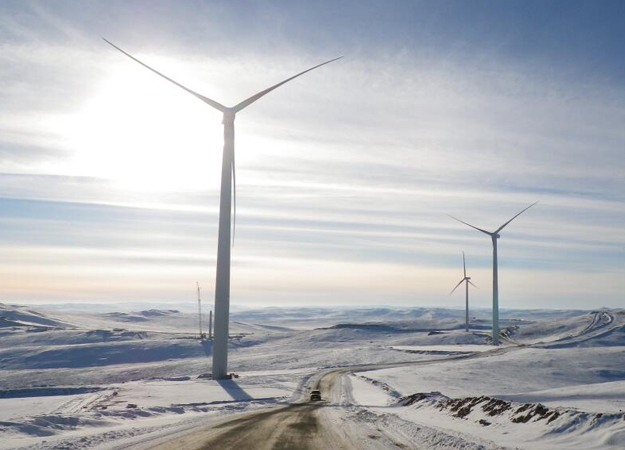
China is expected to reach just under 700GW of cumulative connected wind capacity by 2030, according to latest analysis from Wood Mackenzie.
By the end of the decade China will reach a cumulative grid-connected wind capacity of 689GW, accounting for 67% of global share, Wood Mackenzie’s China wind power outlook 2021-2030 has predicted.
Wood Mackenzie principal analyst Xiaoyang Li said: “Stimulated by China’s target of 1200GW of wind and solar set for 2030, 408GW of new capacity will be added from 2021 to 2030.
“Onshore wind comprises 82% of the total during the outlook, with an average annual capacity of 33GW.”
Northern regions continue to dominate the onshore wind market due to favourable wind conditions and policies.
The market analyst found that in Inner Mongolia, Hebei and Shanxi provinces newly developed renewable energy bases are driving the high growth, featuring state-owned developers signing gigawatt-level development contracts directly with local governments.
Li said: “Apart from new projects, substantial volume of ageing turbines with legacy technology installed in the last decades represents a good opportunity for repowering activities.
“Relevant policies to address the feasibility and profitability of repowering in China are needed to unleash the repowering market potential, which is expected to hit 24GW capacity by 2030.”
A series of policies were released to support sustained wind market growth following China’s 2060 target announced in September 2020.
These include the 2030 renewable capacity target, annual renewable portfolio standard (RPS) targets, as well as benchmarked on-grid tariffs to stabilise onshore wind project profitability after subsidies ended in 2020.
There are sufficient onshore wind projects in the pipeline to support China’s 10-year outlook. The number of renewable bases more than tripled from 25 to 78 from the second half of 2020 to the second half of 2021, amounting to 260GW of total capacity being planned and under construction across 14 provinces.
Established onshore wind supply chain and larger-scale wind turbine models will allow onshore wind levelised cost of electricity to decrease by 46% from 2021 to 2030 and drop below coal power’s on-grid tariffs in 2022, stated Wood Mackenzie.
Wind power is not the only winner under the national target; it is also challenged by lower-cost solar power in the post-subsidy era.
The low initial investment for solar projects contributes to a low market-entry threshold and more diversified market players compared to wind projects, which are preferred by state-owned developers.
Hybrid projects are also becoming mainstream, Wood Mackenzie highlighted with the government encouraging development of integrated wind-solar-storage-hydro-thermal projects to alleviate the pressure on the grid network and to support substantial renewable energy online.