Accountants Baker Tilly have warned that the government’s consultation on the future of the renewable energy sector could cause lasting damage.
The consultation on the feed-in-tariff scheme ends on October 23 and companies are expecting a big cut in subsidies.
Baker Tilly renewable energy head Mark Stewart said: “This consultation has all been about the Department for Energy and Climate Change trying to manage its costs and the Government’s response will have very serious implications for the whole renewables sector.”
Baker Tilly assesses that to remain within the budget cap of £100m for the FiT scheme until 2018/19, developers and investors will have to accept the internal rate for each technology type, for solar investors that is 4%, for onshore wind 5% and for hydro 9%.
If these caps don’t allow the cost of the scheme to be managed within budget, DECC plans to close the scheme for new applicants as soon as possible, with January 2016 the most likely date.
Mark Stewart added: “Many of our clients have strongly argued that the proposed hurdle rates for onshore wind and solar projects in particular are well below that which would attract investment in the FiT scheme going forward.
“Sadly for the renewables sector, this consultation is but one of a number of recent UK Government announcements which have rocked the industry.”
The Renewables Obligation for large solar projects of 5MW or more closed in April 2015, consultation on the intention to close the RO for both smaller solar projects and onshore wind runs from April 2016, though the onshore wind proposal suffered a defeat in the House of Lords today.
“According to Scottish Renewables, the voice of the industry in Scotland, the impact of these measures could be in the region of £3bn of lost investment and over 5,000 jobs lost in Scotland alone,” added Stewart.
Baker Tilly said debate would intensify about government renewables policy in the coming weeks after the UK signed an agreement to build an £18bn nuclear plant at Hinkley Point, with 3GW capacity, with opponents arguing that the same investment would deliver 20GW if invested into offshore wind.
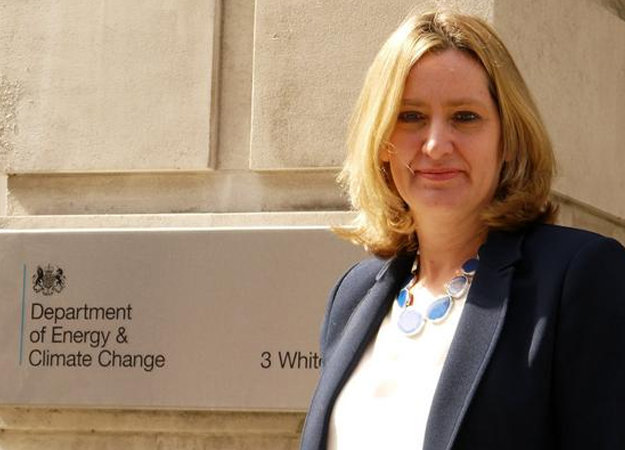
Image: Amber Rudd (DECC)