


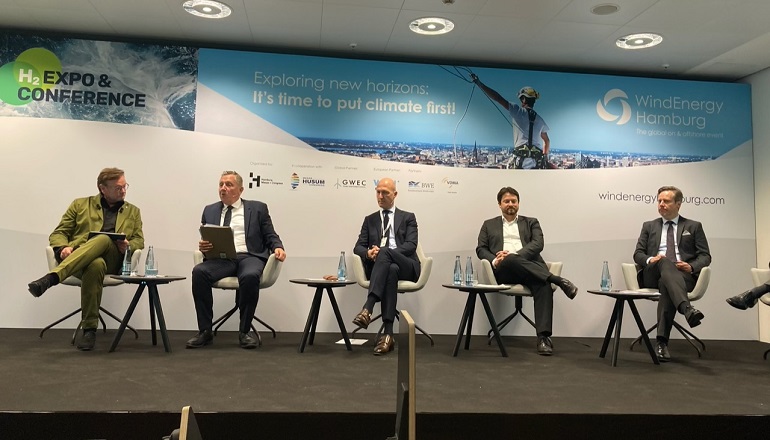
Trade groups have called for the European Commission to ensure a “fair and consistent” implementation of the proposed revenue price cap to prevent the measure negatively impacting investment in renewables.
Speaking at WindEnergy Hamburg, industry associations including WindEurope and BWE said that while the proposed €180/MWh inframarginal price cap was needed to reduce the impact of the energy crisis on families and businesses, it should be seen as a temporary measure and not get in the way of efforts to reach ambitious climate and renewables targets.
“It is important that the price cap is implemented across all EU Member States with no deviations or exemptions,” Sven Utermöhlen, CEO Offshore Wind at RWE Renewables and Chairman of WindEurope told journalists.
“It is the right thing to do, but the renewable energy sector needs stability and predictability, and we must not lose sight of the long-term goal of investment in new renewable power plants.
“If it becomes a patchwork of different rules then it will not work. It is also important that the cap applies to all revenues, whether generated via PPAs, hedging instruments or power exchanges”, Utermöhlen added.
Björn Spiegel, Vice President of the German Wind Energy Association, called for the Commission to make quick decisions on the proposed legislation to ensure rapid relief for consumers as well as certainty for energy sector investors.
However, long-term solutions to the energy crisis are also needed, Spiegel added. “The only way out of this crisis is a huge integration package for faster investment in renewables and grids.”
The price cap regulation has been proposed by the Commission in response to the increase in electricity prices, which have risen 10-fold in the past year, driven by the high price of gas due to Russia’s invasion of Ukraine and demand from global markets.
If implemented, it will be applied to so-called inframarginal electricity producers such as renewables, nuclear and lignite, which provide electricity to the grid at a cost below the price level set by the more expensive marginal producers, such as natural gas.