


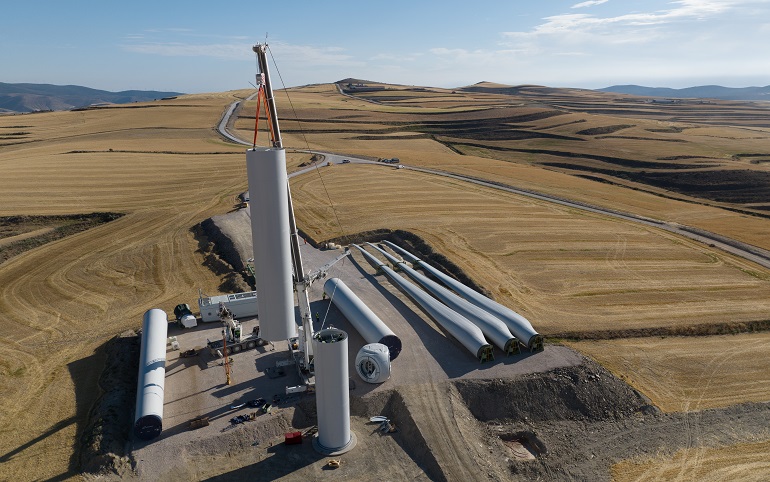
RWE has made its first-ever use of Soft-Spot foundations at the 41MW Rea Unificado onshore wind farm in north-eastern Spain.
The technology developed by engineering firm GES utilises an insulating layer of expanded polystyrene beneath the concrete spread foundations, distributing loads onto a “doughnut-shaped” surface rather than directly onto the subsoil.
It enables a reduction in the diameter of the foundation slabs as well as in the volume of concrete used, according to RWE.
This will “significantly reduce both construction costs and CO2 emissions while increasing stability”, said RWE onshore wind and solar CEO for Europe and Australia Katja Wünschel.
The first of nine 4.53MW turbines to be installed at Rea Unificado in Soria is currently under construction and the wind farm is due to be fully operational by the end of this year.
RWE’s CEO of Renewables Iberia Robert Navarro said: “I would like to thank our development and construction teams for making this innovation in Rea possible.
“We have been able to significantly reduce our construction effort and material costs and save several tonnes of CO2.
“Now we are entering the next, decisive construction phase and will successively erect all nine turbines.”
GES wind project construction manager Alfonso Rey added: “Our proposal to RWE for Rea Unificado wind farm was the implementation of a soft spot foundation model, which optimises the consumption of concrete and steel, making the project more cost-effective and environmentally more sustainable.
“GES is excited to be able to collaborate with RWE in future challenges like this one.”