


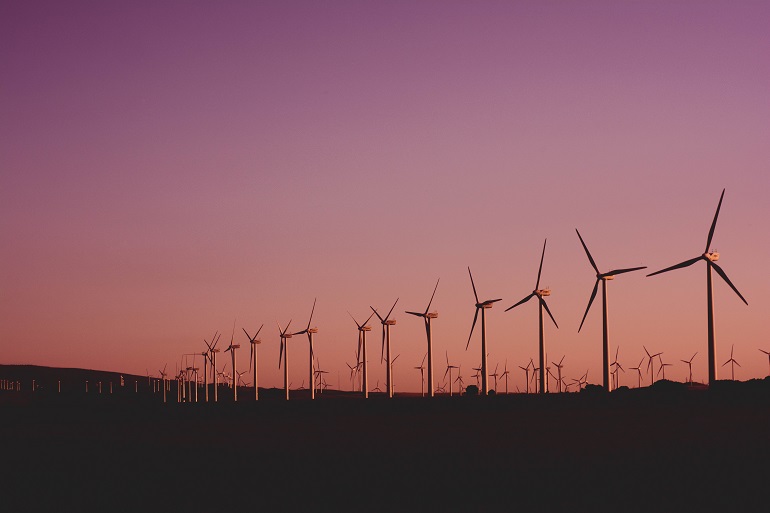
Total wind generation in the UK rose by 13% in 2019 to a record 64 terawatt-hours (TWh), according to the Government’s Digest of United Kingdom Energy Statistics (DUKE).
Wind speeds in 2019 were down on 2018, by 0.31 knots on average, but this was more than offset by additional capacity coming online, the government said.
Onshore wind generation increased by 6.5% to a record 32TWh in 2019, with 600MW of new capacity added last year.
The largest new sites include the 177MW Dorenell and the 88MW Kype Muir in Scotland, as well as the 97MW Clocaenog Forest in Wales.
Offshore wind generation increased by 20% to 32TWh as well, the largest increase of any technology, a result of new capacity that came online in 2019 and late 2018.
New offshore wind capacity included the completion of the Beatrice expansion, the 1218MW Hornsea 1 becoming operational in stages and the first 179MW stage of East Anglia 1 coming online.
The three schemes are all supported by Contracts for Difference (CfD).
Load factors for offshore wind were higher than those for onshore wind, partly because wind speeds are much stronger off the coasts, but also because breezes can be strong in the afternoon, matching times of high electricity demand, unlike wind on land.
Despite lower wind speeds for the year, load factors increased for offshore and onshore wind generation.
For offshore wind these rose from 40.1% to 40.4%.
For onshore wind load factors rose from 26.4% to 26.6%.
The UK Government said this can be explained due to the additional capacity that came online late in 2018, meaning it contributed comparatively more to 2019 generation.
On an unchanged configuration basis, the load factor for offshore wind rose from 38.3% to 39.6% in 2019.
The round-up of figures in DUKES, published by the Department for Business, Industry and Industrial Strategy (BEIS), confirm that renewables provided a record 37.1% of the UK’s electricity last year, up from 33.1% in 2018.
BEIS noted that 2019 was the first year in which renewables accounted for more than one third of total electricity generation, mainly due to increased onshore and offshore wind capacity.
Wind alone generated a record 20% of UK electricity last year (10% from onshore wind and 10% from offshore wind).
Low carbon generation, comprising renewables and nuclear, hit a record 54.4%, despite nuclear falling to 17.3% as a result of outages and maintenance, said BEIS.
Gas generated 40.6% while coal fell to an all-time low of 2.1%
RenewableUK deputy chief executive Melanie Onn said: “At a time when so many things seem uncertain, the consistent rise of renewables, keeping the UK powered up, bringing billions in investment in new energy infrastructure and creating highly skilled jobs all over the country, is a terrific success story we can all be proud of.
“Today’s figures confirm just how far we’ve come in the revolution in power generation; in 2010 less than 7% of our electricity came from renewables – now it’s 37%.
“But we know that to tackle the existential threat of climate change, we need to decarbonise not just electricity, but also heating and transport, where progress has been glacial.
“We need innovative power sources like floating wind, wave and tidal power, renewable hydrogen and a massive expansion in battery storage to get us to net zero emissions as fast as possible – so there’s no time to rest on our laurels.”
REA chief executive Nina Skorupska said: “The growth of renewable electricity in the UK continues to be a major success story.
“The UK continues to break records and the success of getting to just under 40% renewable electricity generation in little over decade needs to be celebrated.
“However, the slow and modest growth of decarbonising heat and transport also needs to be highlighted. The UK’s success in power decarbonisation is not yet being replicated in these hard to treat sectors.
“The UK still has legally binding targets to reach 15% renewable energy by this year. These figures for 2019 demonstrate that power is doing all the heavy lifting in getting us towards that target.
“Urgent and ambitious policy now needs to be brought in to address this slow progress in heat and transport, this needs to be done now if we are to remain on track to meet our 2050 net zero targets.”