


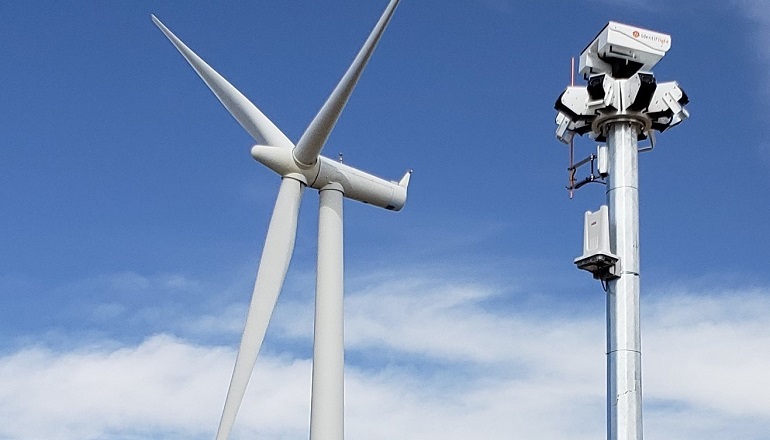
A recent study has shown that a US-based technology has significantly reduced avian collisions at a wind farm in Wyoming.
The IdentiFlight technology was the subject of an independent study, titled ‘Automated curtailment of wind turbines reduces eagle fatalities’, recently published in the Journal of Applied Ecology.
The study, conducted by The Peregrine Fund, in cooperation with Western EcoSystems Technology and the US Geological Survey, at the US wind farm resulted in an 82% reduction of eagle fatalities.
IdentiFlight senior vice president Ben Quinn said: “Avian collisions with turbine blades have been a long-time concern in the wind industry.
“The IdentiFlight avian detection technology was developed to address this problem and promote the successful coexistence of avian wildlife and wind energy.
“We now have conclusive evidence that IdentiFlight can be utilised as a mitigation and minimization solution for current and future wind projects.”
The Peregrine Fund global conservation science director, and study lead author, Chris McClure added: “These results show that using the IdentiFlight system can lessen numbers of fatalities of eagles at wind energy facilities, reducing the conflict between wind energy and raptor conservation.
“As this technology continues to develop and improve, it has the potential to greatly impact raptor conservation around the globe.”
The IdentiFlight system is commercially deployed at projects around the world and has actively tracked and documented over 2.2 million eagle tracks.
Documented images increase by more than 10 million every year with over 47 million images of protected species gathered.
With every image, the IdentiFlight system becomes more accurate and robust, by using artificial intelligence techniques, the company said.
One of the advantages of the IdentiFlight system is its “ability to learn from the massive amounts of data” collected daily from eagles and other protected bird species around the world.
Quinn added: “In fact, IdentiFlight has achieved dramatic improvements in the time since this study was completed with expanded capabilities and new avian species added to better serve global needs, including Red and Black Kites, Golden Eagles, Bald Eagles, Wedge-tailed Eagles, White-tailed Eagles, Lesser Spotted Eagles and Condors.
“We are excited about the future of IdentiFlight and look forward to continuing to demonstrate that wildlife and wind generation can coexist.”
IdentiFlight towers operate as an autonomous system detecting, classifying, and curtailing specific turbines that could pose a risk to the bird.
The system detects a bird as far as one kilometre away, classifying it as a protected species such as an eagle (or not) in real time.
The IdentiFlight towers can be positioned to cover multiple turbines in a single wind farm.
When installed as a network with overlapping aerial coverage, the systems work together to provide the most protection possible for avian activity in the area.