


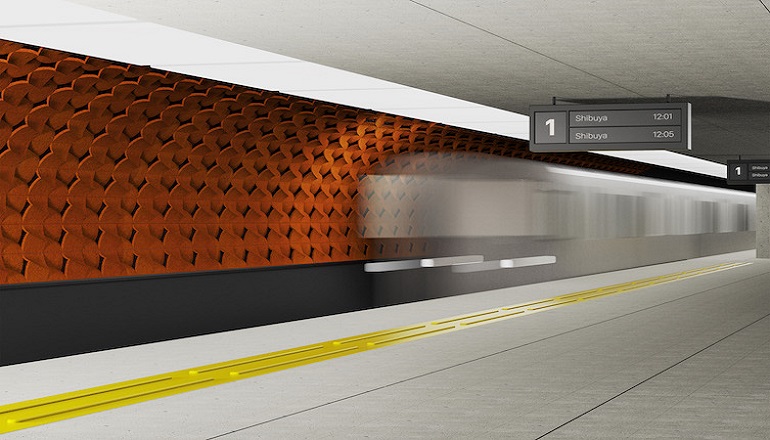
Solar and wind resources have been harnessed for design innovations by two chosen finalists in this year’s Lexus Design Award.
One is a “Solar Desalination Skylight” created by Denmark-based Henry Glogau.
The innovation uses seawater to emit natural diffused light, to make drinking water, and to produce energy from leftover salt.
Glogau is a New Zealander who recently graduated from the Royal Danish Academy in Copenhagen, Denmark.
The other is “Terracotta Valley Wind”, created by Intsui Design, a design group based in Tokyo, consisting of Chenkai Guo, Baohua Sheng, Yilei Lyu, Yu Zhang, all of whom are pursuing Masters degrees at Tama Art University’s Integrated Design department.
The terracotta evaporative cooling system is for subway stations, using the wind created by trains.
In total six finalists were picked from over 2000 entries from around the world.
The six finalists are being mentored by leading design experts, Joe Doucet, Sabine Marcelis, Mariam Kamara, and Sputniko!. They recently attended a five-day virtual workshop to help them produce a prototype of their ideas, with a budget of £21,000 per project.
Mentor Mariam Kamara said: “I’ve been struck by the level of optimism and commitment the finalists have shown in their designs.
“In this new Covid-19 reshaped world, their visions and sensitivity are a gift to us all.
“Each one of them was incredibly passionate about the projects and demonstrated a strong motivation to delve deeper and do the necessary research to strengthen the final result. I look forward to seeing where they take their designs in the coming months.”
The judging panel will select the Grand Prix Winner based on the six finalists’ final prototypes and presentations in April 2021.
This year marks the ninth edition of the Lexus Design Award, which supports up-and-coming creative talent whose ideas embody the three principles of the Lexus brand – Anticipate, Innovate, and Captivate – with an emphasis on design that leads to a better tomorrow.
Lexus Design Award judge Greg Lynn said: “In the middle of a changing climate and a global pandemic there was an urgency to the problems being addressed by the designers… and there was also a humanity and intimate scale.”