


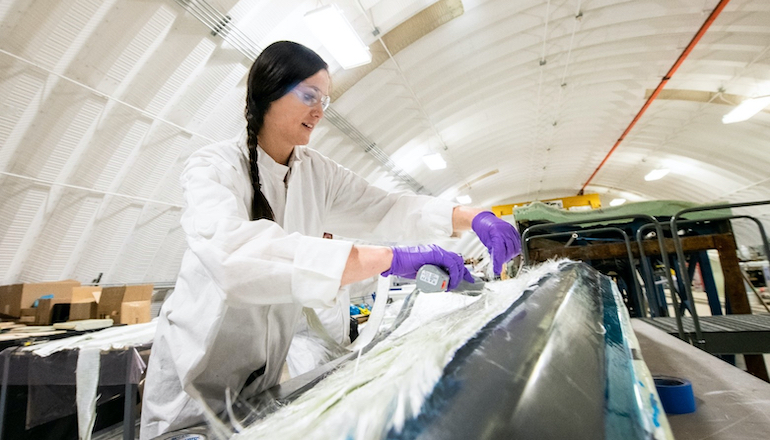
The US Department of Energy’s National Renewable Energy Laboratory (NREL) has validated the use of a thermoplastic resin for wind turbine blades that can be recycled.
Researchers demonstrated the feasibility of thermoplastic resin by manufacturing a nine-metre-long turbine blade using the resin, which has been developed by a Pennsylvania company called Arkema.
The structural integrity of a 13-metre-long thermoplastic composite blade, which was manufactured at NREL, has also now been validated.
NREL said that in addition to the recyclability aspect, the thermoplastic resin can enable longer, lighter-weight and lower-cost blades.
NREL senior engineer Derek Berry said: “With thermoset resin systems, it’s almost like when you fry an egg. You can’t reverse that.
“But with a thermoplastic resin system, you can make a blade out of it.
“You heat it to a certain temperature, and it melts back down. You can get the liquid resin back and reuse that.”
Berry is co-author of a new paper called ‘Structural Comparison of a Thermoplastic Composite Wind Turbine Blade and a Thermoset Composite Wind Turbine Blade’ which appears in the journal Renewable Energy.
The other authors, also from NREL, are Robynne Murray, Ryan Beach, David Barnes, David Snowberg, Samantha Rooney, Mike Jenks, Bill Gage, Troy Boro, Sara Wallen and Scott Hughes.
NREL has also developed a technoeconomic model to explore the cost benefits of using a thermoplastic resin in blades.
Current wind turbine blades are made primarily of composite materials such as fibreglass infused with a thermoset resin.
With an epoxy thermoset resin, the manufacturing process requires the use of additional heat to cure the resin, which adds to the cost and cycle time of the blades.
Thermoplastic resin, however, cures at room temperature.
“The process does not require as much labour, which accounts for about 40% of the cost of a blade,” NREL said.
The new process could make blades about 5% less expensive to make, the researchers said.
Murray said” “The thermoplastic material absorbs more energy from loads on the blades due to the wind, which can reduce the wear and tear from these loads to the rest of the turbine system, which is a good thing.”
The thermoplastic resin could also allow manufactures to build blades on site, alleviating a problem the industry faces as it trends toward larger and longer blades.
As blade sizes grow, so does the problem of how to transport them from a manufacturing facility, NREL said.
The work was funded by the US Department of Energy Advanced Manufacturing Office.