


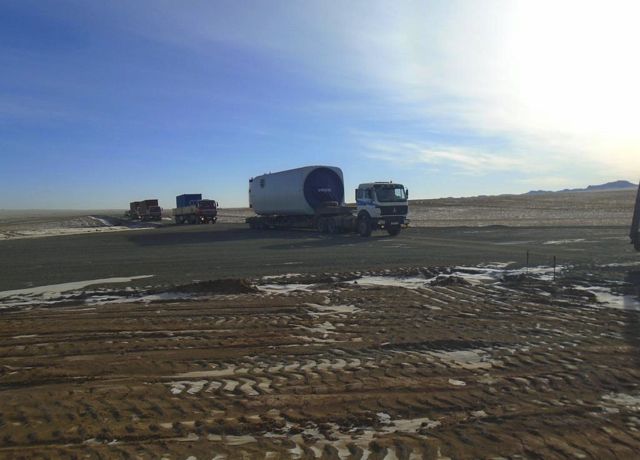
Vestas has formed a partnership with Danish transport and logistics outfit DSV Panalpina that will see the latter execute and manage the turbine manufacturer’s general freight and special project transportation.
“By combining Vestas’ volume and experience in special project transport with DSV Panalpina’s broader logistics expertise and scale, the partnership aims to simplify Vestas’ global transportation setup, as well as generate economies of scale and efficiencies for both companies,” Vestas said.
The deal will combine DSV Panalpina’s global footprint of 60,000 employees in 90 that provide a range of services across the entire supply chain, with Vestas’s volume and experience in special project transportation.
Vestas said it has delivered and installed more than 70,000 wind turbines in 80 countries and has about 500,000 inbound shipments a year utilising over 900 vessels.
The partnership does not include outbound transport for Vestas’s service business.
Vestas group president and chief executive Henrik Andersen said: “We are very excited to partner with DSV Panalpina to meet the growing demand for our sustainable energy solutions.
“Combined with the increasing size of wind turbines, the global demand for wind energy is making logistics and transportation more complicated and we must therefore scale our business efficiently.
“Partnering with DSV Panalpina is a great example of our intention to engage further in close and mutually beneficial partnerships across our value chain, improving both our operational scope, efficiency and sustainability performance.”
DSV Panalpina chief executive Jens Bjorn Andersen said: “We are proud to enter into this strategic partnership with the world leader in renewable energy.
“Vestas and DSV Panalpina have a long-standing relationship, which we are excited to take to the next level.
“Wind energy is a high-growth and highly complex global industry, and we look forward to further enhancing our position in this market through our far-reaching global logistics network.”
The partnership also includes a mutual commitment to reduce and eliminate carbon dioxide emissions related to transport and logistics.