


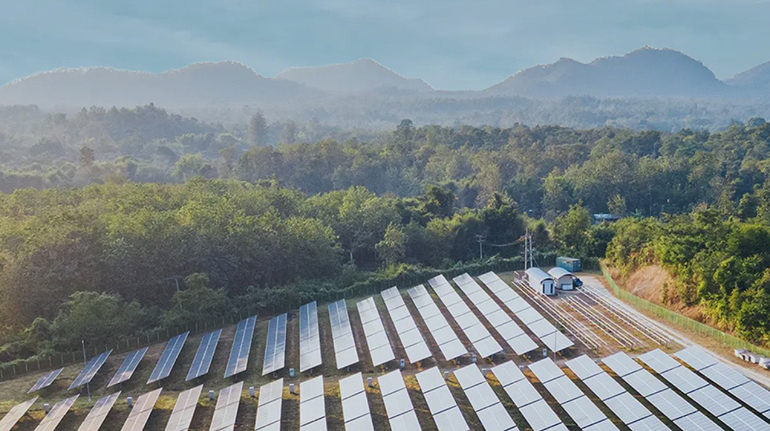
A report by think tank Climate Analytics has calculated $8tn of investment is needed for new renewables and $4tn for grid and storage infrastructure to deliver the 2030 tripling goal agreed at COP28.
Combined, the amount works out at $2tn a year on average.
The report assessed how fast different regions need to act to triple global renewables based on current capacities and future needs.
it found using climate finance to mobilise $100bn a year for the rollout in Sub-Saharan Africa – five times current investment levels – would ensure energy access for all and align the region with the global target.
Renewables capacity in Sub-Saharan Africa needs to scale rapidly by a factor of seven (double the global average) due to historic underinvestment and energy access needs.
The OECD is forecast to double its renewables by 2030, but it needs to triple, stated the report.
Accelerating action in line with this would close 60% of the global gap between forecast capacity in 2030 and the tripling goal.
“$2tn a year sounds like a cost, but it’s really a choice,” said the report’s lead author and Climate Analytics expert Neil Grant.
“We are set to invest over $6tn in fossil fuels over this decade – more than enough to close the tripling investment gap.
“Faced with this choice, I’d go with the safest, best value option – renewables.”
Co-author on the report and head of policy at Climate Analytics Claire Fyson added: “The OECD needs to triple renewables but is currently way off target.
“Countries in the region claiming to be climate leaders need to walk the talk, not just by ramping up renewables at home, but by coming through for other regions which need finance to contribute to the tripling goal.”
Asia needs to scale slightly faster than the OECD, almost quadrupling its renewable capacity by the end of the decade, though it is the only region broadly on course for the tripling goal, driven mostly by policies in China and India.
However, the significant coal and gas pipelines in these countries risks stranded assets or slowing the transition.
As renewables are set to grow strongly in the region, new fossil fuel plants are not needed and should be avoided.
“The renewables industry stands ready to deliver on the global tripling goal,” said Global Renewables Alliance chief executive Bruce Douglas.
“But to get there in time, we need governments to take urgent action to turbocharge an already buoyant renewables market.
“Public finance is key, especially international support to provide access to low-cost capital for emerging markets to join the renewables era, ensuring a clean, secure and just transition for all.”
Tripling renewables by 2030 is not the end of the story. The report found they need to continue growing strongly beyond the end of the decade, scaling up five times by 2035 relative to 2022, to limit warming to 1.5°C.
As governments start to develop their 2035 targets for the next round of NDCs, they should consider how to follow through on the tripling ambition collectively agreed at COP28.