


AceOn Group has completed one of the UK’s first trials of a hybrid hydrogen and battery retrofit propulsion system for marine vessels servicing offshore wind turbines.
The renewable energy company said the £4.6 million RESTORE project marks a breakthrough moment for maritime decarbonisation.
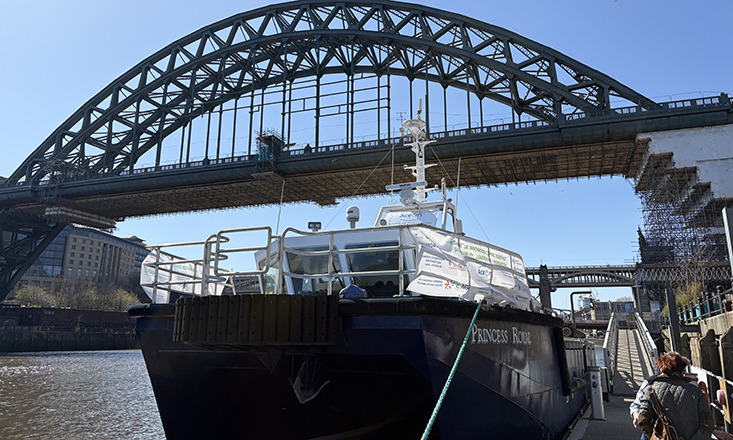
The project transformed Newcastle University’s Princess Royal vessel (pictured) into a cutting-edge research platform capable of servicing offshore wind turbines with zero emissions.
RESTORE (Retrofittable Propulsion System for Electric Vessels with Hydrogen Range Extender) was funded by the UK Department for Transport and delivered through Innovate UK’s Clean Maritime Demonstration Competition (CMDC3).
The initiative brought together a consortium including AceOn Group, Offshore Renewable Energy Catapult, Engas Global, Newcastle University, Liverpool John Moores University, University of Liverpool, Taurus Engineering, and CAGE Technologies.
The aim is to replace the fossil-fuelled power and propulsion systems of CTVs with green hydrogen and battery storage-based alternatives.
AceOn Group chief executive Mark Thompson said: “AceOn was proud to lead a multidisciplinary team at the forefront of maritime innovation.
“This project is a testament to the UK’s potential in clean maritime technology – creating jobs, supporting exports, and proving that British innovation can lead the world.
“Our experience with hydrogen is just the beginning; we’re committed to turning bold ideas into globally competitive products.”
The project culminated with a landmark demonstration in the North Sea and River Tyne.
AceOn said the trial in the North Sea, reaching EDF Renewables’ offshore wind farm in Blyth, showcased the system’s viability.
Chi Onwurah, MP for Newcastle Central and chair of Parliament’s Science, Innovation and Technology Committee, boarded the vessel.
She said: “It was absolutely fantastic to step onboard one of the UK’s first hydrogen/battery-powered retrofitted boats, which paves the way for marine developments across the world.
“Forward-thinking, innovative technology solutions, such as the RESTORE project, are transformative and can revolutionise the maritime industry.
“This boat and project represent the power of innovation in tackling global energy challenges, steering us toward a cleaner, greener future for marine.”
The Princess Royal, based near Blyth, showcased its operational range using battery-electric propulsion supported by a hydrogen generator, underscoring the potential for zero-emission marine operations.
This project was part of the CMDC3 and delivered by Innovate UK. CMDC3 is part of the Department’s UK Shipping Office for Reducing Emissions (UK SHORE) programme, a £206m initiative focused on developing the technology necessary to decarbonise the UK domestic maritime sector.