


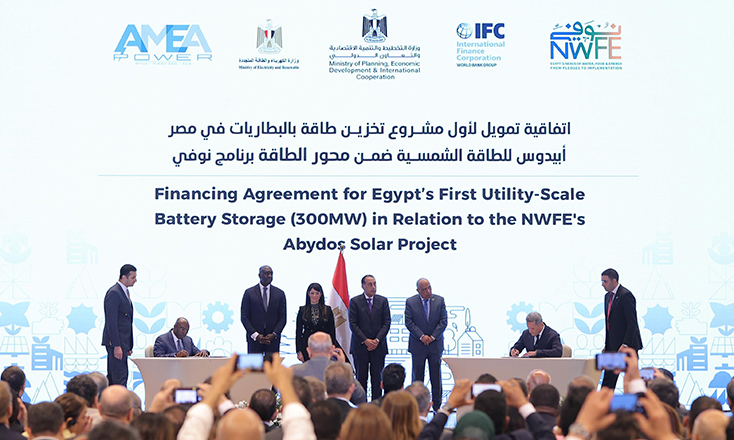
AMEA Power has achieved financial close for Egypt’s first-ever utility scale battery energy storage project.
The 300MWh BESS project is an extension of AMEA Power’s operational 500MW solar PV plant in Aswan Governorate, which was commissioned in December 2024.
The BESS will receive a $72m debt package from IFC which will finance the integration of the project into the operational solar plant.
This latest milestone further cements the strategic partnership between AMEA Power and IFC, which also includes the recently commissioned 500MW Amunet wind farm in Ras Ghareb, Egypt.
The collaboration also extends beyond Egypt, with projects such as a 120MWp solar PV plant in Metbassta, Tunisia.
This BESS integration represents the first initiative to move forward under Egypt’s accelerated 4GW Emergency Renewable Energy Programme – a government-led effort designed to address rising electricity demand by leveraging affordable, clean energy solutions and decreasing dependence on imported natural gas.
AMEA Power chairman Hussain Al Nowais said: “At AMEA Power, we are committed to transforming the energy landscape through innovation, speed, and local collaboration.
“Achieving financial close for Egypt’s first utility-scale BESS project –following the successful launch of our 500MW wind farm in Egypt – is a clear demonstration of our ability to deliver large-scale renewable energy projects.
“We are proud to play a leading role in supporting Egypt’s energy transition and grid resilience.”
The BESS project is scheduled to be commissioned in July 2025.
IFC’s managing director Makhtar Diop said: “Meeting Egypt’s rising energy demand – especially in the summer – requires bold solutions, and we are proud to deepen our collaboration with a ready-to-scale partner like AMEA Power.
“This investment delivers sustainable infrastructure that strengthens the grid today while laying the foundation for a cleaner, more resilient energy future in Egypt.
“This is modelling efficient transition – one that brings value for the country through advanced technologies and skills.”