


Between 85 and 140 terrawatt-hours of long duration energy storage of more than eight hours can be deployed globally to enable power grids to become carbon net-zero, according to a new report.
The Long Duration Energy Storage (LDES) Council’s report, produced in collaboration with McKinsey & Company, said the storage volumes would eliminate between 1.5 to 2.3 giga-tonnes of CO2 currently produced each year by allowing grid energy imbalances to be met by renewable sources opposed to fossil fuels.
This is equivalent to 10-15% of total emissions from today’s power sector.
The report also sets out timeline scenarios for LDES deployment over the next decades that coincide with recent pledges to deliver net-zero nationally.
It said that there is increasing momentum behind LDES deployments with around $3bn invested in companies involved in the technology in the last five years, and an expected 25-35GW/1TWh of capacity to be deployed globally by 2025 with approximately $50bn investment.
The LDES Council is a global chief executive-led organisation formed to accelerate worldwide decarbonisation.
The report details the application of LDES technologies, the flexibility requirements needed in high-renewables future power grids, and analysis of the investment and unlocks required.
It is the result of collaboration between the 24 founding Council members and is based on advanced power systems modelling using more than 10,000 real data points supplied by its technology providers.
The modelling focused on identifying the lowest cost way to transition to net-zero power systems, with LDES playing a key role alongside lithium-ion and H2 turbines.
The report concluded that achieving net-zero power grids by 2040 requires a global deployment of 1.5-2.5TW and 85-140TWh of LDES, which will account for 10% of electricity consumed worldwide and require an estimated investment of $1.5 trillion to $3 trillion.
This represents between four and seven times the total TWh global lithium-ion battery storage deployment today and between five and eleven times the total investment in renewable power in 2020, the report said.
Energy Dome chief executive and founder Claudio Spadacini said: “LDES technologies reduces our exposure to the unpredictability of wind and solar power.
“While renewable energy generation is rapidly increasing it does not match the variations in demand such as peaks in the morning and evening of each day.
“LDES technologies can store electrical energy for hours, days and even weeks to fulfil energy supply needs in critical junctures for the grid, all whilst scaled and at a competitive cost in a time currently when electrical energy consumption is continually on the rise.”
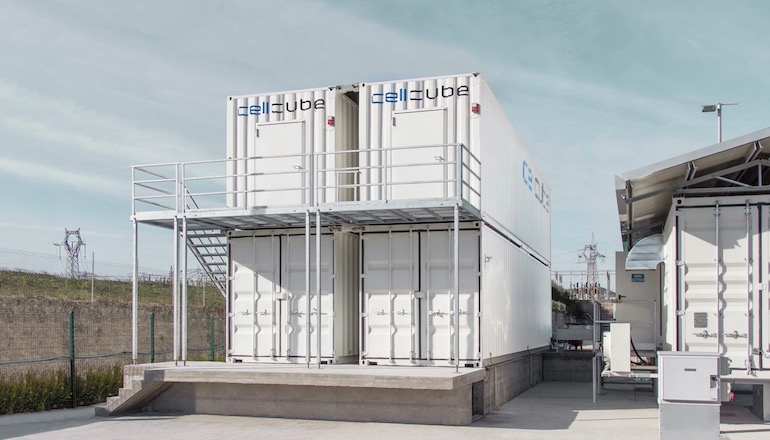
CellCube (pictured) is one of the founder members of the Council.