


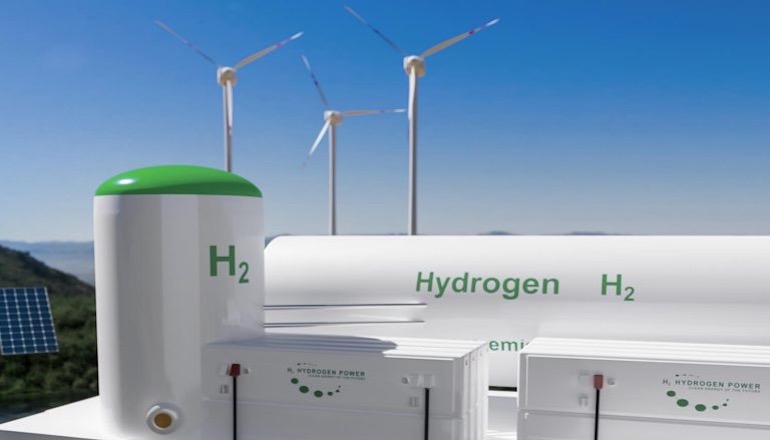
Without hydrogen and low-emission compounds based on it, the European Union’s climate targets will not be met, according to a new report from Dii Desert Energy and ILF Consulting Engineers.
In principle, all the elements are already in place, from production to transport to consumption, to enable a rapid ramp-up of production and deployment, the study found.
However, there are significant obstacles at every stage of the value chain that need to be overcome to give the process the necessary speed, it added.
The European Union’s ambitious climate targets, including the “Fit for 55” target of reducing greenhouse gas emissions by 55% by 2035, depend directly on the large-scale introduction of low-emission molecules such as hydrogen.
The Dii Desert Energy think tank, together with the engineering consultancy ILF Consulting Engineers, has analysed which factors are crucial for the necessary market ramp-up.
The study, which incorporates insights from 31 leading companies across the entire hydrogen value chain, emphasises that the technology and basic infrastructure for hydrogen production, transport and use are largely in place.
However, significant barriers remain, delaying the rapid development of the sector.
Key among these are financial, regulatory, and infrastructure challenges that must be addressed to achieve the EU’s energy transition objectives.
The study identifies financing as one of the biggest obstacles to scaling up hydrogen projects.
Large-scale hydrogen production and transport require significant capital investment.
However, the risks associated with these projects are still difficult for traditional financial institutions to assess.
Although initiatives such as the European Hydrogen Bank and the H2Global Fund are working to mitigate the risks of the initial phase, the inflow of private capital is still insufficient to meet the sector’s needs within such an ambitious timetable, the study concluded.
In the next phase of development, it will be essential for the EU and its member states to provide mechanisms to secure the necessary large-scale investments to mobilise sufficient private capital be mobilised to tackle the necessary large-scale projects, it added.
Simon Roth, lead author of the study at ILF, said: “Technical solutions exist, but effective scaling will depend on improved financing structures and clearer regulatory frameworks.
“A swift adoption of EU directives and standards at the national level would be a strong catalyst for the expansion of the European hydrogen market.”
The study emphasises that collaboration along the hydrogen value chain – between policymakers, project financiers, project developers, technology producers, transport providers and buyers – is important to align supply and demand.
Long-term supply contracts are still rare, but necessary to enable investment decisions that drive the growth of the sector, according to the analysis.
To support the growth of the sector, the study argues for greater government involvement in the development of hydrogen transport infrastructure.
In addition, establishing a strategic reserve of low-emission molecules could also help to stabilise market conditions and reduce investor uncertainty.
Roth added: “Without targeted public support and innovative financing mechanisms, it will be difficult for the hydrogen economy to develop at the pace needed to achieve Europe’s climate targets.
“Strategic cooperation and early financial support are crucial to transforming low-emission molecules from niche projects into established energy solutions.”
In the long term, according to the study authors, low-emission molecules will be produced at competitive prices.
Cornelius Matthes, chief executive of Dii Desert Energy, said: “Low-emission electricity is already competitive in the MENA region.
“Furthermore, we need to succeed in implementing an international system for pricing CO₂ emissions.
“Then the question of state support will no longer arise.”