


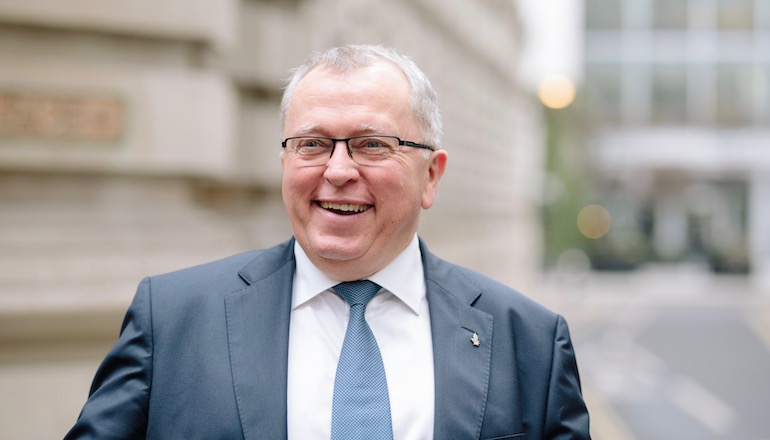
Equinor has pledged to grow its renewables capacity tenfold by 2026, as part of measures in its newly launched “climate roadmap.”
The move sets the Norwegian oil and gas producer on a path to develop as a “global offshore wind major” that will enable it to reach its long-term aim of reducing the net carbon intensity of energy produced by at least 50% by 2050, from initial production to final consumption.
As part of the “climate roadmap” the developer is also targeting carbon neutral global operations by 2030.
Equinor president and chief executive Eldar Saetre (pictured) said: “Today we are setting new short-, mid- and long-term ambitions to reduce our own greenhouse gas emissions and to shape our portfolio in line with the Paris Agreement.
“It is a good business strategy to ensure competitiveness and drive change towards a low carbon future, based on a strong commitment to value creation for our shareholders.”
Saetre said there will have to be “significant changes” in the energy markets, with Equinor’s portfolio changing accordingly to remain competitive. “We are now looking 30 years into the future, and it is not possible to predict an exact shape and pace of the transition. Not for society and not for us,” he added.
Though less oil will be produced in a low carbon future, Saetre said “value creation” from oil and gas will still be high, and renewables give “significant” new opportunities to create attractive returns and growth.
“Equinor’s strategic direction is clear. We are developing as a broad energy company, leveraging the strong synergies between oil, gas, renewables, carbon capture and storage and hydrogen.”
Equinor will continue addressing its own emissions in line with the emitter pays principle. “But, we can and will do much more,” Saetre added.
As part of the energy industry, he said Equinor must be part of the solution to combat climate change and address decarbonisation more broadly in line with changes in society.
The ambition to reduce net carbon intensity by at least 50% by 2050 takes into account scope 1, 2 and 3 emissions, from initial production to final consumption.
By 2050 each unit of energy produced will, on average, have less than half of the emissions compared to today. Equinor said it will achieve this primarily through “significant growth” in renewables and changes in the scale and composition of its oil and gas portfolio. Operational efficiency, CCUS and hydrogen will also be important, and recognised offset mechanisms and natural sinks may be used as a supplement, according to the energy company.
In 2026, Equinor expects a production capacity from renewable projects of between 4GW and 6GW around 10 times higher than today’s capacity, implying an annual average growth rate of more than 30%.
Towards 2035, Equinor expects to increase installed renewables capacity further to 12GW to 16GW, dependent on availability of attractive project opportunities.
“In order to combat climate change, governments, business and society must find new and sustainable solutions together.
As a pioneer in CCUS, Equinor is engaged in building a European value chain, capturing and storing CO2 from third-party industrial sites. This, combined with a strong position within natural gas, makes Equinor prepared for future growth in hydrogen, which offers large scale opportunities for zero emission energy,” added Saetre.
In January 2020, Equinor announced plans to reduce absolute greenhouse gas emissions from its operated offshore fields and onshore plants in Norway by 40% by 2030, 70% by 2040 and towards near zero by 2050, through electrification, energy efficiency measures and new value chains such as carbon capture and storage and hydrogen.
Equinor is aiming to reduce the carbon dioxide intensity of its globally operated oil and gas production to below 8 kg per barrel of oil equivalent by 2025, five years earlier than the previous ambition. The current global industry average is 18 kg CO2 per barrel (International Association of Oil and Gas Producers).
Equinor sets a new ambition to reach carbon neutral global operations by 2030. The main priority will be to reduce greenhouse gas emissions from own operations. Remaining emissions will be compensated either through quota trading systems, such as EU ETS, or high-quality offset mechanisms.