


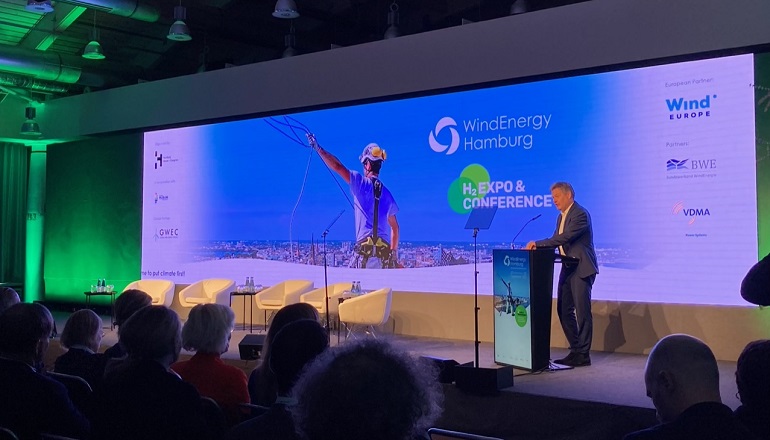
Federal Economics and Climate Protection Minister Robert Habeck (pictured) has said both Germany and Europe must strengthen production capacities for renewable energies.
The Minister was speaking at the the third virtual production summit to strengthen energy transition technologies.
He said: “We have to strengthen the production capacities for renewable energies and power grids in Germany and Europe.
“This is important for the success of the energy transition and to secure jobs and added value in Germany and Europe.
“That is why we have identified three priority measures today, which we will press ahead with in a targeted and rapid manner together with all stakeholders.
“The first is in the area of financing. Here we need both investment cost subsidies and temporary operating cost subsidies.
“Secondly, we also need hedging instruments to cushion the risks for manufacturers of wind turbines or when expanding the electricity grid, and thirdly we need strong innovation support. Innovations are the strategic key to the energy transition.”
The focus of the summit was the results of last year’s stakeholder consultation.
The German Energy Agency (dena) presented a final report on this on behalf of the Ministry and bundled the opinions and recommendations from the group of stakeholders.
The Federal Ministry of Economics and Climate Protection derived key points from this overall report and presented them today at the meeting by Minister Habeck.
The focus is on three priority measures that are now to be pushed ahead quickly in order to strengthen production capacities for photovoltaics, wind turbines and power grid components in Germany and Europe.
The paper names three priority measures that are now to be implemented, provided that the appropriate financial resources are available.
These include the recommendation that the existing instruments for investment cost promotion are to be adapted or, if necessary, new instruments are to be designed in order to enable the development and expansion of the PV, wind and electricity grid value chains.
A concept for a transformation fund is to be drawn up in line with industry-specific needs and EU state aid requirements.
The German government is taking up the recommendation of the stakeholder process after the introduction of a hybrid capital participation program.
The instrument of super write-offs or investment premiums should also be examined more closely and used to ramp up production capacities for transformation technologies, it said.
In order to reduce the production costs per unit, to strengthen the competitiveness of European manufacturers and thus provide a further incentive for the expansion of local production capacities, we also want to work actively on suitable instruments for promoting operating costs, the Ministry added.
The BMWK is also developing a concept for a national / European industrial electricity price and intends to present proposals in the first half of 2023.
Furthermore, in order to temporarily secure or cushion the special risks of manufacturers in the context of wind energy and electricity grid expansion, the Ministry wants to clarify the causes and needs together with the stakeholders and, with the support of actors such as KfW, develop a proposal for a suitable security instrument.
Finally, from March the government will prepare a feasibility study for the resettlement of the PV industry in DEU.