


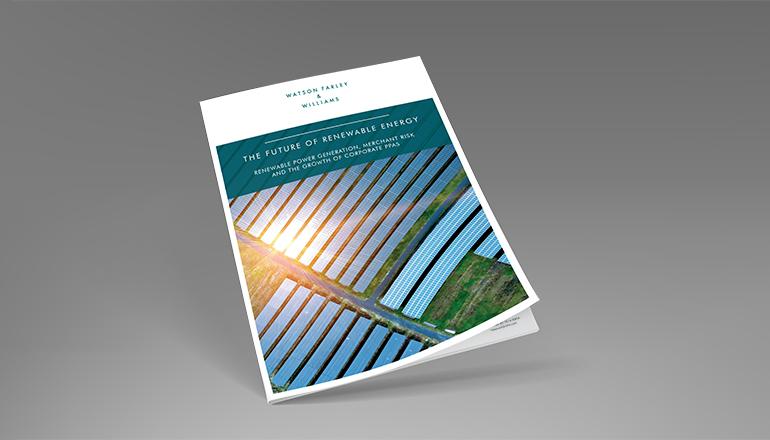
International legal group Watson Farley & Williams has expressed “profound optimism” in the European renewables market, which it says is the “net positive effect” of a drive towards subsidy-free project financing in the region.
The group’s positive outlook for the market reflects responses to a global survey of 150 senior financial and development players in the industry that it commissioned from Acuris.
Infant technologies may have been allowed to grow to grid parity from government support via permitting, subsidies and energy transition targets, but it is “freedom from the chains of government interference” that is the leading driver of alternative financing models, said the group at the launch of The Future of Renewable Energy report in London on 9 October.
The most popular model is the corporate power purchase agreement (CPPA), which is supported by companies increasingly making 100% renewable energy consumption a leading priority, said the group.
Companies best suited to survive in this climate are those that are able to understand and manage merchant risk, engage with and develop CPPAs and help tackle intermittency through energy storage solutions.
Fifty-eight percent of survey respondents believed that green issues trump all other metrics for offtakers, including security of supply, price certainty and cost savings.
These companies are now considering CPPAs rather than “electricity suppliers with guarantees of origin, which are not considered reliable enough from an additionality perspective”, said David Diez, the group’s Madrid-based regulatory and public law partner for global energy.
“These projects do not depend on regulatory remuneration, so the impact of potential regulatory change on the income of projects like these is much less than a few years ago,” he said.
Diez said the momentum towards independence is set to continue: “The preference is to establish long-term grid parity projects instead of participating in auctions, in order to avoid future dependency on regulatory regimes and dealing with governmental bodies,” he said.
Key findings of the report revolve around energy storage, which is expected to continue to attract significant investor interest in Europe.
“Nearly half of the European respondents [to the survey] are investing in storage infrastructure,” with a “further third actively seeking to do so,” said the group.
Batteries are the most promising solution for the future. A limited number of suitable sites will curb further expansion of pumped hydro, the currently dominant storage technology, according to the legal group.
The “micro picture” of batteries is not rosy now, conceded the group, but market desire is to “get in early” and the current “level of involvement is surprising” it said.
Lower costs and advances in technology to ensure longer life are evident now and expected to improve driven by manufacturing learning rates, cell chemistry improvements and economies of scale, finds the report.
The solution is attractive to investors because “deployed at scale, batteries have the potential to turn the vision of renewable baseload into a reality,” states the report.
Investment in energy storage will play out in various ways, with three main trends already evident, according to Watson Farley & Williams.
Co-locating renewables projects with batteries with an increase in “integrated thinking” among utilities and developers is increasingly evident, said the group.
“They want generation capabilities or timed power deployment, so they can charge and discharge during periods of low and peak demands. They can also enjoy cost sharing or … savings through shared infrastructure when co-locating,” states the report.
Standalone battery systems are another rising trend for those who “want to discharge energy quickly to address inevitable balancing difficulties in the grid with an increasing mix of renewable sources”.
The third trend is for “behind-the-meter batteries”, wherein, under a private wire arrangement, corporates charge at a period where the price is low and discharge when it would be high.
The approach is more appealing to large corporates than to developers, however. It “aims at increasing potential profits rather than revenue generation. It offers certainty from a corporate perspective with all of the opportunities and far fewer drawbacks,” said the group.