


WindEurope has expressed concerns about the findings of a new report recommending that Germany should split its electricity pricing area into five bidding zones.
The European Electricity Transmission System Operators (TSOs) Bidding Zone Study evaluated 14 alternative bidding zone configurations specified by ACER, split into the Nordic region and Central Europe.
The simulation results showed a higher economic efficiency for all German–Luxembourgish split configurations (ranging from €251m to €339m for the 2025 target year), where the split of Germany–Luxembourg into five bidding zones performs the highest among the analysed alternative configurations in terms of economic efficiency.
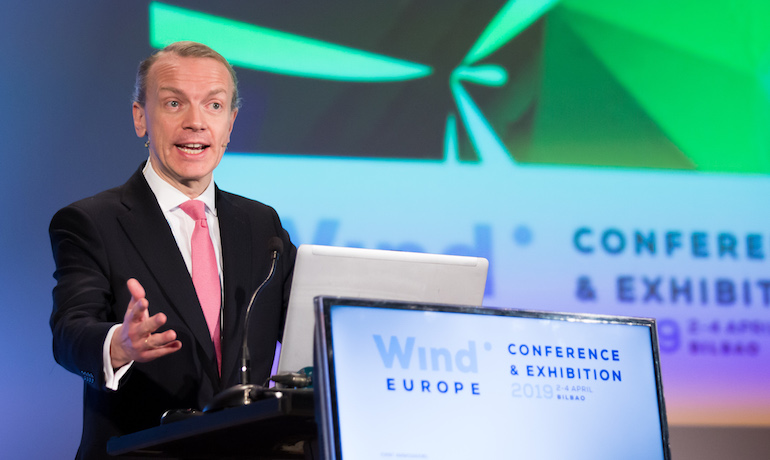
In response to the recommendation, WindEurope chief executive Giles Dickson (pictured) said: “There may be arguments for splitting up existing bidding zones in electricity markets.
“But it would increase uncertainty about the future revenues of power plants.
“And that would undermine investments in new renewables. Building more renewables is top priority right now. It needs huge investments.
“Which needs maximum possible certainty. Don’t make things even harder by adding new uncertainty.”
A bidding zone is a geographical area within the electricity market where electricity can be bought and sold without considering physical grid limitations.
The review aimed to establish optimal bidding zone configurations in Europe to maximise economic efficiency and cross-zonal trading opportunities, while maintaining security of supply.
The report contains two proposals: one for Central Europe and one for the Nordic region, which are to help Member States decide on whether to amend or maintain current bidding zone configurations.
Aside for the recommendation to split the German region, in Central Europe the analysis found that the Dutch split configuration also shows a slight positive effect on economic efficiency (€9m for the 2025 target year).
It also concluded that the French and Italian alternative configurations show a negative effect in economic efficiency.
For the Nordic Region, none of the studied alternative bidding zone configurations provide a higher economic efficiency.
The result shows a negative change in economic efficiency for the configurations ranging from €2m to €35m compared to the status quo, for the target year 2025.
To facilitate stakeholder engagement, ENTSO-E and TSOs will organise a webinar on 6 May 2025 to present and discuss the outcome of the BZ Study.
The webinar will provide an opportunity to understand the results of the study, ask questions, and contribute to the discussion on bidding zone configurations.