


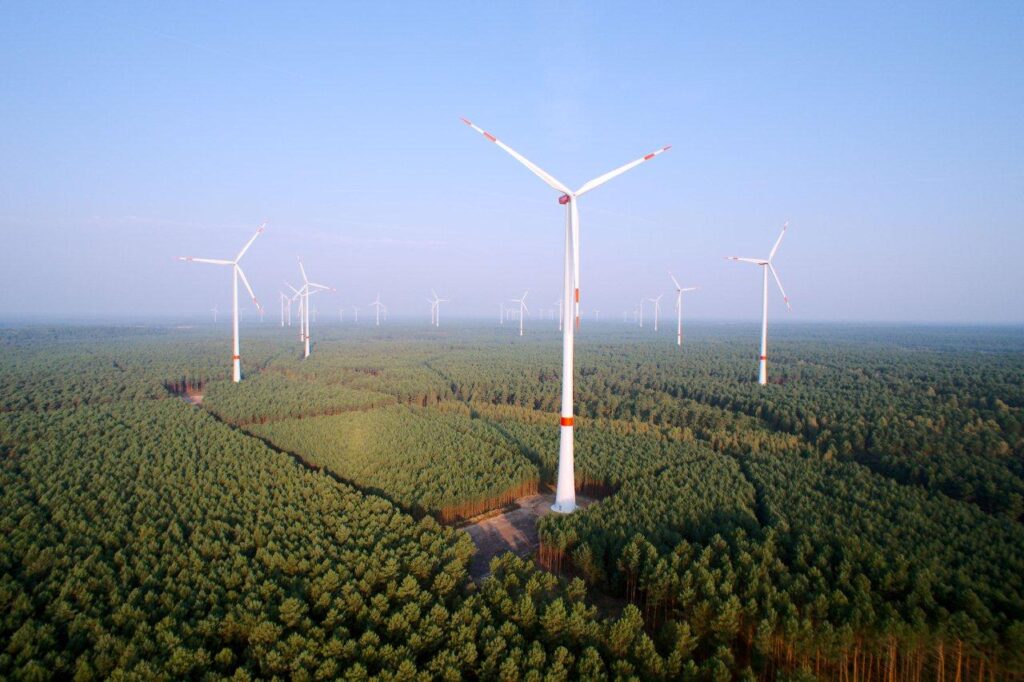
The German federal government has unveiled a new energy package to accelerate and promote the expansion of renewables.
At the heart of the “Easter package” is the principle that the use of renewable energies is in the overriding public interest and serves public safety, it said.
Under the proposals, the expansion on land and at sea will be raised so that at least 80% of Germany’s gross electricity consumption should come from renewable sources by 2030.
The expansion of offshore wind energy is to be based on two equal pillars in the future.
In addition to the tendering of areas that have already been pre-examined, areas that have not yet been explored will also be advertised in the future.
New areas will be made available for the expansion of photovoltaics, and the participation of municipalities in onshore wind and solar projects will be expanded.
In addition, locations with weak wind will be increasingly developed and the framework conditions for the expansion of photovoltaic roof systems improved.
The expansion of renewable energies and grids is being accelerated by removing obstacles and streamlining planning and approval procedures.
The federal requirements plan for the expansion of the transmission grids is being updated and new projects are being included so that the grids can keep pace with the expansion of renewable energies.
With the abolition of the EEG surcharge, the regulations for self-consumption and the privileging of industry will be simplified enormously and a major contribution will be made to reducing bureaucracy in energy law, the government said.
Vice chancellor Robert Habeck said: “The Easter package is the accelerator for the expansion of renewable energies.
“We will almost double the share of renewable energy in gross electricity consumption within less than a decade.
“We are tripling the speed of renewable expansion – on water, on land and on the roof.
“In the future, renewable energies will be in the public interest and serve public safety. This is crucial for picking up the pace.
“Overall, with the Easter package we are creating the conditions for energy security and energy sovereignty in Germany.
“At the same time, it lays the foundations for Germany to become climate-neutral.”
The Easter package passed by the federal cabinet today will now be forwarded to the German Bundestag and will then go into the parliamentary legislative process in a next step.