


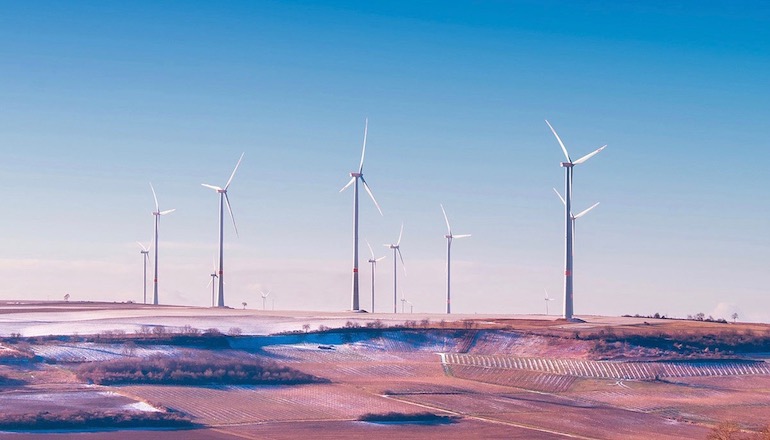
Germany has put forward an “outstanding” set of measures for renewable energy expansion in its so-called Easter Package, according to trade group WindEurope.
Central to the Easter Package is the definition of renewable energies as an overriding matter of public interest and public security, WindEurope said.
“This will speed up the permitting of new renewables projects and reduce delays caused by legal appeals,” it said.
Military interests are excluded from the definition.
WindEurope chief executive Giles Dickson said: “The Easter Package is an outstanding package of measures that will drive the expansion of wind energy, both onshore and offshore.
“Big auction volumes. A clear long-term auction schedule. And crucially, major steps to simplify the permitting of wind farms – without which the targets would be purely academic. It’s a great example for the rest of Europe.”
At the heart of the package are changes to Germany’s Renewable Energy Law (EEG) to enshrine a new renewable energy target of 80% in total electricity consumption by 2030.
By 2035 Germany aims to get almost 100% of this electricity demand from renewables.
The package adjusts yearly auction volumes as well as annual wind energy installation targets.
Already from 2025 onwards Germany wants to install 10GW of new onshore wind a year.
To make this possible annual auction volumes will increase to up to 12GW per year.
According to this trajectory Germany would have 115GW of onshore wind by 2030, WindEurope said.
For offshore wind the package envisions new targets of 30GW by 2030, 40GW by 2035 and at least 70GW by 2045.
To make this a reality the German government pledged to prioritise offshore wind in maritime spatial planning, shorten permitting procedures and hire additional staff in the permitting authorities.
In the future, the expansion of offshore wind in Germany would be based on two equally important pillars.
Auctions of sites that have already been pre-surveyed by state authorities on the one hand and auctions of sites that have not yet been pre-developed on the other hand.
Centrally pre-developed areas would be auctioned based on price, awarding 20-year Contracts for Difference (CfDs) to successful bidders.
Not centrally pre-developed areas would be auctioned according to a catalogue of criteria which would also include qualitative criteria.
“It is essential that these qualitative criteria allow differentiation between individual bids – without significantly increasing planning and financing costs,” WindEurope said.
It added that the government is also looking into options of auctioning wind energy in combination with renewable hydrogen production.
Germany will also bring forward a summer package to May that will include a national repowering strategy, new measures to ensure sufficient sites for wind energy, improvements to permitting, a new strategy to harmonise the expansion of wind energy with biodiversity and nature protection.