


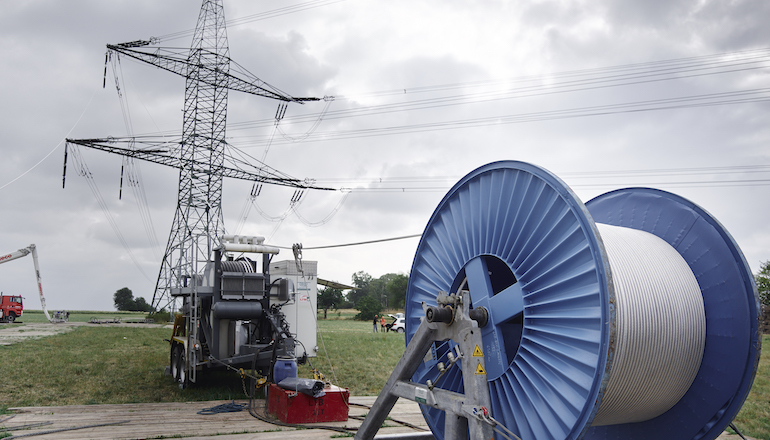
Transmission system operators TenneT and 50Hertz have applied for a new approval procedure to accelerate the planned NordOstLink interconnector.
With the “Act on the Restart of the Digitization of the Energy Transition”, which came into force a few days ago, the Bundestag has cleared the way for a new approval procedure to “significantly accelerate” electricity connections currently being planned.
The direct current-underground cable connection NordOstLink will integrate offshore wind power in the North Sea into the German transmission grid.
“Together with our partner TenneT, we have therefore decided to take advantage of the acceleration potential of the new legal regulations,” said 50Hertz chief executive Stefan Kapferer.
“The NordOstLink will thus become an important pilot project. The energy transition needs more speed, which is why it is now time to tackle it together and find pragmatic solutions,” Kapferer added.
In Heide, the starting point of NordOstLink in Schleswig-Holstein, 50Hertz and TenneT are also planning a new type of electricity hub.
For the first time, it is possible to connect direct current connections such as NordOstLink straight to other DC lines.
This technical innovation is the entry into a meshed direct current grid.
In the future, this will enable electricity to be transported efficiently and flexibly over long distances to the consumption centres.
Last year, the legislator decided on a streamlined approval procedure for new line projects approved by the Federal Network Agency, including an option that the preference space method can also be applied to projects that have already been confirmed, such as NordOstLink.
The preferential area procedure is the first stage of the approval procedure, which involves the Federal Network Agency developing a 5km to 10km-wide preference area.
Within it the project developers plan the site-specific route in the subsequent planning approval procedure.