


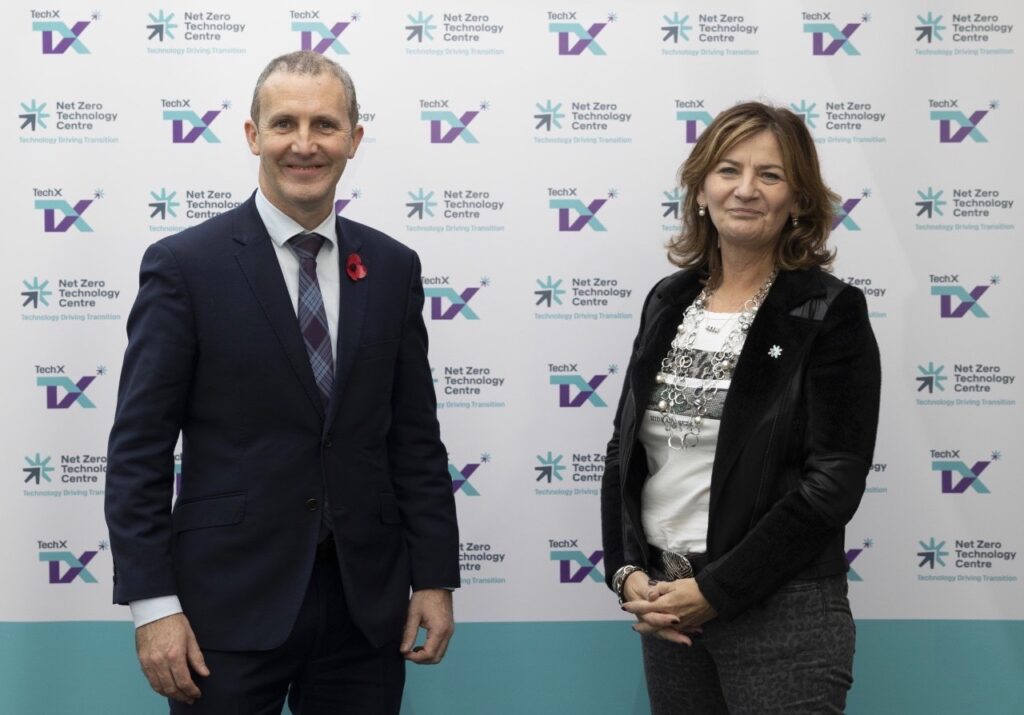
The Net Zero Technology Centre has launched an international research study initiated by a collaboration of technology and research organisations from around the world, the results of which will be presented at COP27 in 2022.
The Centre’s Technology Driving Transition Global Summit hosted in Glasgow at COP26 was opened by Michael Matheson MSP (pictured: left), Scottish Government Cabinet Secretary for Net Zero, Energy and Transport.
The Summit brought together ten research organisations to present their flagship research on the energy transition.
The international organisations include TNO (The Netherlands), NREL (US), Rice University Carbon Hub (USA), C-SIRO (Australia) and NERA (Australia), InnoTech Alberta (Canada), PRNL (Canada), RCGI (Brazil), and the Industrial Decarbonisation Research & Innovation Centre (IDRIC) and Scottish Carbon Capture & Storage (SCCS) in the UK.
Each will contribute to the Technology Priorities for a Net Zero Integrated Energy System: a global perspective study.
Enhancing international collaboration is a key priority for the COP26 Presidency, and is seen as a catalyst in accelerating technology innovation for a global impact.
Creating an integrated energy system requires countries, governments, technology centres and research institutions to collaborate to achieve global climate change goals.
Working together, the research organisations will analyse key energy transition technologies across mature hydrocarbon basins, including blue and green hydrogen, offshore wind, oil and gas electrification, direct air capture and carbon capture, utilisation and storage.
The study will identify technology gaps and innovation priorities to accelerate an integrated net zero energy future.
The Net Zero Technology Centre presented the findings from its Closing the Gap and Integrated Energy Vision reports, highlighting how the energy transition could contribute £2.5trillion (€2.9trillion) to the UK economy and create over 200,000 new jobs.
Matheson said: “Innovation and technology have a key role to play in the energy transition and our target of achieving net zero emissions by 2045.
“Net Zero is a Global Innovation Challenge, and along with that and collaborative international research, it will enable us to accelerate the journey to achieving that goal.
“Scotland’s position on oil and gas is clear – our focus must now be on achieving the fastest possible just transition for the oil and gas sector – one that delivers jobs and economic benefit, and also ensures our energy security, and meets our climate obligations.
“We have a real opportunity to become a global leader in energy transition and can play a pivotal role in helping other countries decarbonise and begin their energy transition journey.
“Offshore Energy Integration offers considerable opportunities to support the North Seas transition to Net Zero and recognises the role that technology – such as carbon capture and use of hydrogen – can play in helping both.
“Scotland and the UK meet our greenhouse gas emission reduction requirements.
“The skills, expertise and infrastructure of the oil and gas sector and its supply chain will be vital in unlocking these opportunities for the integration and ensuring a just transition to a greener and fairer economy and society.
“This study demonstrates how innovation and technology with impact will support the world in achieving the fastest possible Just Transition for the oil and gas sector, one that delivers jobs and economic benefit, ensures our energy security, and meets our climate obligations.”
UK Government Minister for Scotland, Malcolm Offord added: “This initiative by the Net Zero Technology Centre to bring together research experts has been hugely worthwhile.
“Encouraging collaboration between countries to exchange valuable ideas is our best hope for securing a smooth, sustainable and economically-beneficial transition away from fossil fuels.
“In the North Sea in particular, we have immense energy expertise, and that knowledge can put us front and centre of the new green industrial revolution.
“Held at the same time as the crucial COP26 summit, this week’s conference has sparked innovation that will help us all achieve our Net Zero goals.”