


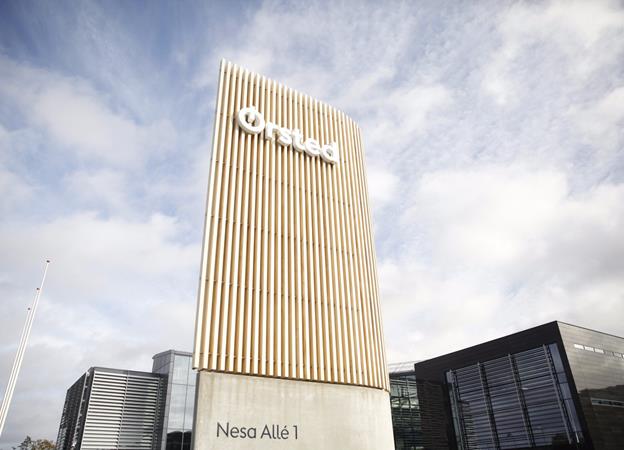
Orsted has been ranked first place as the world’s most sustainable company according to the Global 100 ranking, making it the first energy company to reach the top spot.
The global offshore wind developer outperformed more than 7300 companies with billion-dollar revenues to reach first place in Corporate Knights’ 2020 index of the Global 100 most sustainable corporations in the world, announced annually on the side lines of the World Economic Forum in Davos.
Orsted chief executive Henrik Poulsen said: “We’re immensely proud to rank as the world’s most sustainable company.
“From our origins as a traditional fossil fuel-based energy company, we’ve transformed into one of the largest renewable energy companies in the world. Every day, we deliver green energy solutions at scale to combat climate change, the defining challenge of our time.”
Toronto-based Corporate Knights, a publishing and research firm, analysed publicly-available data on financial and sustainability indicators of 7395 companies with more than $1bn in revenue.
In the 2020 Global 100 index, 49 companies are from Europe, 29 from the US and Canada, and 18 from Asia.
Since 2006, the company has reduced carbon emissions from its energy generation and operations by 83% and says it is on track to be carbon-neutral by 2025.
Orsted decided to change its business model a decade ago, realising that having fossil fuels as its core business would not be sustainable in the long-term.
The company has since been “instrumental in driving the build-out of offshore wind at industrial scale” and has grown to be the “world leader in offshore wind” and one of the fastest growing energy companies in the world.
Offshore wind is now significantly cheaper than newly built coal- or gas-fired power plants in most parts of the world, making it a key technology in the global transition to green energy.
According to the International Energy Agency (IEA), offshore wind has the potential to provide green power to hundreds of millions of people. However, almost 75% of all global greenhouse gas emissions still come from fossil-based energy, and carbon emissions continue to rise.
Poulsen said: “While we’re grateful to be named the most sustainable company in the world, we’d prefer to see the world develop more sustainably. Global greenhouse gas emissions have been rising for decades and are now at their highest level ever.
“We have no time to lose if we want to halt global warming and halve global emissions by 2030 as recommended by science.
He added: “We have the necessary green technologies at hand to transform the world’s energy systems. Countries and businesses must work together and take bold steps to speed up the green transformation, reduce their emissions and limit global warming to 1.5°C.
“As I see it, we owe it to the current and not least future generations.”
Orsted is now embarking on the “next frontier” in its decarbonisation journey – launching a new programme for reducing carbon emissions in its supply chain.
“We’re strengthening collaboration with our biggest and most important suppliers to work with them on reducing their emissions in line with science and to encourage them to run their operations on green energy,” said Poulsen.
“Orsted has become a sustainable and profitable business by making green energy deployment the keystone of our business strategy. Companies that do not take action now to decarbonise run the risk of seeing their business models come under pressure in the future. We encourage all companies to make decarbonisation a core part of their strategy,” he added.
According to its decarbonisation programme Orsted aims by 2023 to phase out coal from its portfolio of combined heat and power plants and to run them on certified sustainable biomass.
By 2025 the company is targeting 98% carbon reduction in energy generation and operations compared to 2006, making Orsted “essentially carbon-neutral”. Current reduction is 83%.
The company’s car fleet will also be 100% electric by then.
By 2032 Orsted said it will cut emissions in the supply chain and from energy trading by 50% as compared with 2018.
This entails engaging suppliers to increase the share of green power in manufacture, transport and installation of components for offshore wind farms and a gradual reduction in fossil gas trading.