


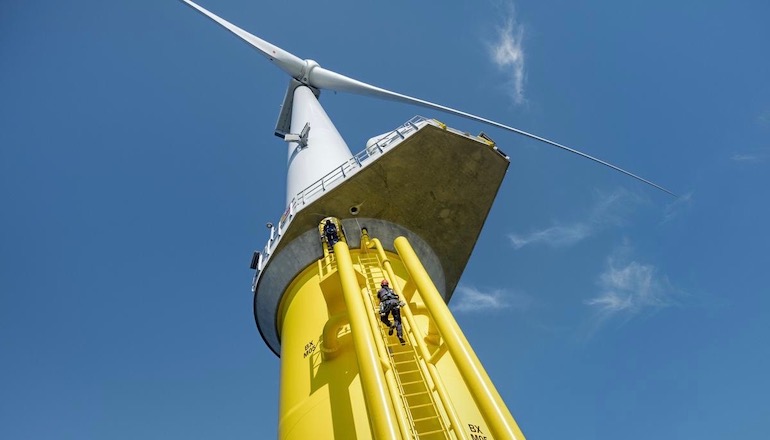
Orsted and ITM Power have revealed a concept for an electrolyser installed in the tower of an offshore wind turbine, to potentially reduce the cost of producing hydrogen.
As a result of their collaboration on the BEIS-funded Gigastack feasibility study ‘Hydrogen supply competition’, the partners have proposed “an electrolyser placed in an offshore wind turbine tower, or very near it, which provides a direct electrical connection to the direct current (DC) link in turbine, with appropriate power flow control and water supplied to it”.
The companies said such an approach could represent a “better design concept” for bulk hydrogen production, as opposed to installing electrolysers at a terminal or platform, remotely from the wind turbine. Advantages of doing so include reduced costs and energy losses.
Where the electrolyser is installed in, or close to, the wind turbine tower, the hydrogen gas would be transported to shore by an underwater or underground pipe network.
“This presents an opportunity to reduce overall costs, as hydrogen pipes cost less per km than power cables. The efficiency of such a system shows potential to define new standards by removing the need for alternate current (AC) rectification,” stated Orsted.
An Orsted spokesperson said the decision was made to publicise the idea, “as the whole industry may benefit from it, and to drive innovation forward, as well as identify areas for future development”.
Demonstrating the concept would require research and development effort, as well as economic evaluation, said Orsted.
Areas for future development, highlighted by the company, include designing an electrolyser module specification suitable for offshore operation, prototype design, build, deployment, and testing, onshore, offshore deployment planning and demonstration and an assessment of operational expenditure costs.