


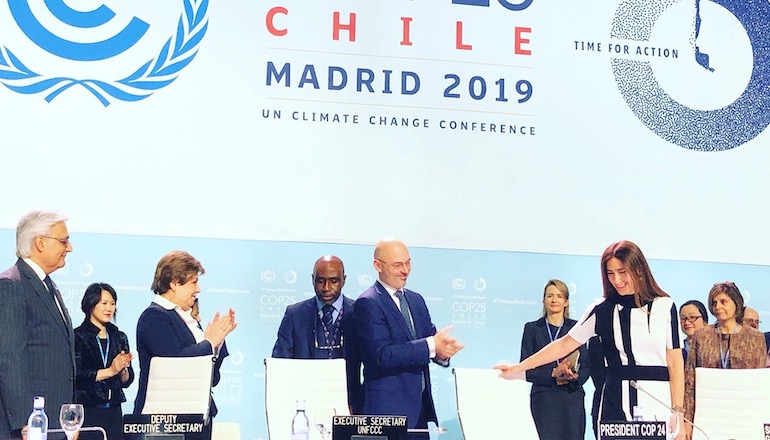
The latest UN climate change negotiations (COP 25) kick off today in Madrid, Spain, with renewables companies calling for more ambitious policy that favours efficiency and clean energy technologies.
Siemens Gamesa said for the world to achieve its emissions and global warming goals, it is “vital to increase dependence on renewable energy”.
The turbine manufacturer also called for more efforts to be made to raise awareness and to train and educate young people in science, technology, engineering and mathematics (STEM).
“This education in STEM areas is key in preparing today’s children for a future in which their role will be very important in reversing climate change,” Siemens Gamesa said.
“Encouraging the choice of this type of careers will allow young people, who are striving to make society aware of the need for immediate government reaction, to play a proper role in this struggle against climate change,” it added.
COP 25 will take place under the presidency of the government of Chile and will be held with logistical support from the Spanish government.
The conference was moved to Spain, after social unrest in Chile resulted in the South American country cancelling its hosting.
A key objective of COP25 is to raise overall ambition also by completing several aspects with respect to the full operationalisation of the Paris Climate Change Agreement, the UN Framework Convention on Climate Change (UNFCCC) said.
Last year at COP24 in Poland, the bulk of the implementation guidelines of the Paris Agreement were agreed, with the exception of Article 6.
Article 6 is to provide guidelines for how international climate markets will work, as a main component of the world’s economic toolbox for addressing climate change.
Other focus areas at COP25 will include adaptation, loss and damage, transparency, finance, capacity-building, indigenous issues, oceans, forestry, gender and more.
Notably, the provision of finance and technology is crucial for developing countries to green their economies and build resilience, UNFCCC said.
UN Climate Change executive secretary Patricia Espinosa said: “This year, we have seen accelerating climate change impacts, including increased droughts, storms and heat waves, with dire consequences for poverty eradication, human health, migration and inequality.
“While we have seen some progress with respect to climate-related financing for developing countries, we will continue to urge developed nations to fulfil their pledge of mobilizing $100bn annually by 2020.
“We also must see overall global finance flows reflect the deep transformation throughout society that we need: away from carbon-heavy investment and towards more sustainable and resilient growth. Drops in the bucket are not enough: we need a sea change.”
In 2020, countries are to submit new or updated national climate action plans, referred to as Nationally-Determined Contributions, or “NDCs”.
According to the UN Environment Programme’s 2019 Emission Gap Report published last week, unless global greenhouse gas emissions fall by 7.6% each year between 2020 and 2030, the world will miss the opportunity to get on track towards the 1.5°C temperature goal of the Paris Agreement.
This means collective ambition would need to increase more than fivefold over current levels to deliver the cuts needed over the next decade for the 1.5°C goal.
Espinosa said: “Current NDCs remain inadequate. If we stay on our current trajectory, it’s estimated that global temperatures could more than double by the end of this century.
“This will have enormous negative consequences for humanity and threaten our existence on this planet. We need an immediate and urgent change in trajectory.
“It’s achievable, but to stabilize global temperature rise by 1.5 Celsius by the end of this century, we need to reduce emissions 45 per cent by 2030 and achieve climate neutrality by 2050.
“It’s an extremely difficult challenge, but meeting it is absolutely necessary to the health, safety and security of everyone on this planet – both in the short- and long-term.”