


Management consultancy McKinsey & Company has published a study revealing a widening “reality gap” between renewable energy project commitments and realisation.
The analysis focuses on Europe and the United States, given both have set explicit targets and have readily available data.
It highlights that the disparity between project target volumes, expected volumes and those reaching final investment decision (FID) is significant – threatening the pace of the energy transition.
“The energy transition: Where are we, really?” suggests corporate, public and private investors are hesitating about deploying capital due to softening business cases, technology cost-competitiveness, and project enabling and market forming policy support.
This is underscored by a significant proportion of announced schemes not yet reaching FID, amplifying the risk of cancellation.
For projects with longer lead times in specific technologies, such as offshore wind, the industry is quickly reaching the stage at which FID status sites will only come online after 2030 – impacting countries’ abilities to reach 2030 Paris Agreement commitments.
This divide is being driven by several factors.
First, the challenging macroeconomic environment and fluctuating investment climates post-COVID are impacting the financing and prioritisation of projects.
This is then compounded by long permitting procedures, grid reform challenges and carbon pricing fluctuations which delay the approval and deployment of new schemes.
Once projects do reach FID, a lack of skilled workers in green technologies is again slowing down the installation and maintenance of systems across the supply chain.
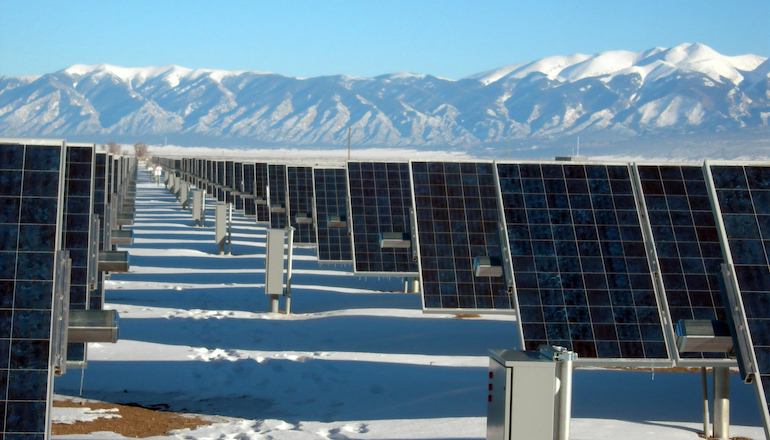
In the US solar capacity additions are projected to stagnate after 2028 at 220GW because of a lack of firm commitments and of the announced capacity expected to come online before 2030, 60% is still pending FID.
In Europe, the solar pipeline is not on track to meet 2030 capacity targets of 600GW, with less than 390GW of capacity planned to be online by the end of the decade.
Of the 114GW of additional capacity expected to come online by 2029, less than 20% has reached FID.
There is the recognition that in some technologies, like solar there is still an ability to accelerate deployment ahead of 2030 goals.
Offshore wind has a gap of only 18GW remaining to meet its overall 2030 target of 176GW.
Of the announced 124GW of European capacity in the sector, 65% is still pending FID.
McKinsey senior partner Humayun Tai said: “Transforming the energy system hinges on the coordinated deployment of interlinked and interdependent technologies.
“A slowdown in deployment in one area of the energy system can cause cascading delays and hamper the growth of other technologies.
“This data confirms the reality gap that we believe the industry is experiencing, especially through inflation and system shocks alongside geopolitical uncertainty, which is seeing international supply chain tensions and trade disruptions.
“It further underscores the need for companies to reassess the current strategies to further drive the transition.”
The analysis highlights decarbonisation technologies such as carbon capture utilisation and storage and hydrogen are also facing bottlenecks, such as the need to build out entire value chains for technology deployment.
In the US, more than 1000 green or blue hydrogen projects have been announced since 2015, but fewer than 15% have reached FID.