


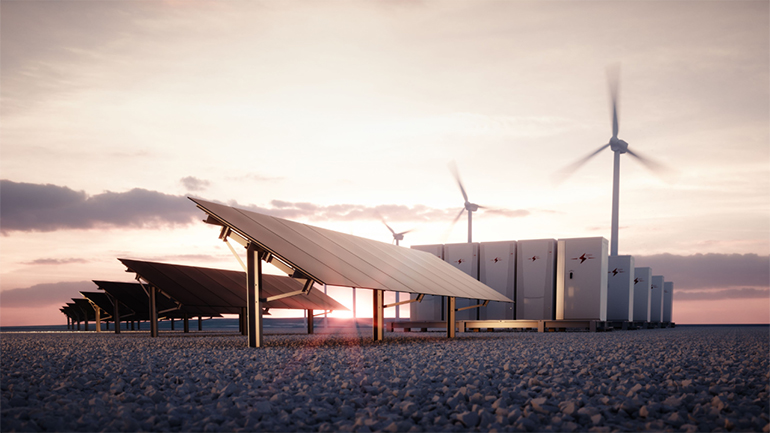
A new report has highlighted the fire risk posed to renewable energy projects by co-located batteries.
The historic underestimation of solar and wind turbine fires continues to imperil the future of energy storage co-located with these assets for more efficient energy generation said the study entitled ‘Double Indemnity: How to tackle fire risk at co-located renewables projects’ from Firetrace International, a supplier of fire suppression technology to the renewables industry.
The co-location of renewables assets is fast-becoming one of the preferred approaches in the transition to clean energy production and American Clean Power reported the deployment of co-located renewables rose by 90% in 2023.
Battery plus solar installations led the way with 10.45GW, and such projects are forecasted by the US Energy Information Administration to account for 81% of new electricity generation capacity this year. To aid this, developers have rightly identified and sought to manage the risk of fire in battery systems, said the report.
However, this same level of vigilance is not being applied to wind or solar assets, among which batteries are often interspersed on co-located sites, said Firetrace.
This is despite the fact that solar and wind infrastructure carry their own fire hazards that could have site-wide consequences in the absence of adequate mitigation strategies.
The report explains that, though less common than battery fire, 1 in 2000 turbines will experience a catastrophic fire and solar farm fires are understood to be underreported.
Consequently, co-located renewables projects that fail to apply the same precaution to solar and wind assets that they adopt for battery systems are only managing half of the overall project’s risk of fire. This leaves owners vulnerable to significant expense in the event of a blaze, with battery losses potentially coming to $2m USD and turbine losses to $9m USD per individual unit. This is before the added loss of project downtime and the impact of reputational damage.
The report outlines local regulations differ from state to state, meaning developers cannot rely entirely on in-built fire suppression systems to meet the required safety standards in place. This uncertainty reinforces the importance of project owners conducting their own comprehensive risk assessments across the sites they operate.
“Last year, the industry’s awareness of energy storage fire risk grew substantially, partly driven by delays and cancellations of projects due to fire concerns,” said Firetrace International’s director of engineering Brian Cashion.
“The International Association of Fire Chiefs also ran a fire risk campaign for energy storage, demonstrating a committed attitude to managing the hazards associated with batteries.
“What this new report illustrates, though, is the prevailing, but mistaken, belief that batteries represent the only high-profile fire risk in co-located renewables projects.”
The Double Indemnity study recommends four steps to reduce a project’s exposure to this threat: Extending battery system fire precaution to co-located assets onsite, independently conducting fire risk assessments, establishing familiarity with local fire regulations and installing fire suppression accordingly and scheduled testing of the condition of operational assets to assess wear and tear.
Cashion added: “Over the last few years at Firetrace, we have drawn attention to our experience of underestimated fire risk on wind farms in our 2021 report, and on solar farms in our 2022 report.
“It is even more imperative now, with more and more battery plus solar or wind projects coming online, to tackle these avoidable losses with sufficient fire suppression systems.
“The only way to fully protect co-located renewables infrastructure, revenue, and reputation is to take equal care of all the assets in the project rather than solely taking care of the most likely fire hazard.”