


RWE intends to significantly expand its renewables activity in the German region of North Rhine-Westphalia, adding 1GW of renewables capacity by 2030.
This will be complemented by 2GW of flexible and hydrogen-compatible back-up capacities, 700MW electrolyser capacity for green hydrogen, plus active support for structural change during the next eight years.
These investments will form part of RWE’s planned investment of €15bn in domestic offshore and onshore wind, solar, batteries, flexible backup capacities and hydrogen projects.
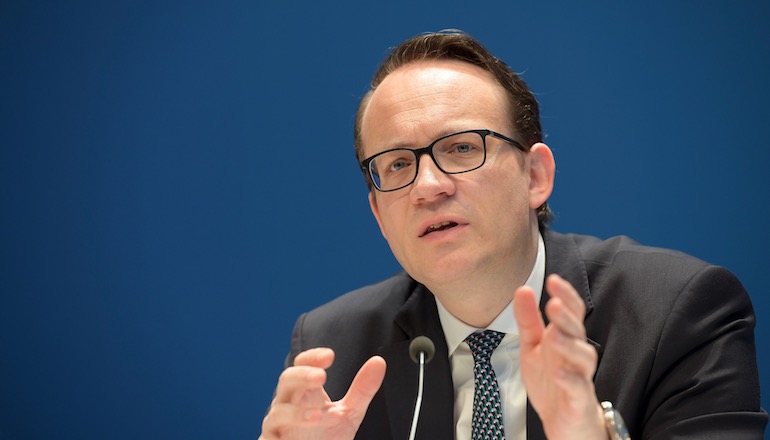
RWE’s bundle of measures to transform the industrial state of North Rhine Westphalia were presented by Andreas Pinkwart, Minister of Economic Affairs in North Rhine-Westphalia and RWE CEO Markus Krebber (pictured).
Pinkwart said: “North Rhine-Westphalia is a strong industrial state and we want to remain this.
“That is why we are working on accelerating the expansion of renewable energies, gas and hydrogen power plants in order to enable a climate-friendly restructuring of our economy and society.
“That is why I am grateful that RWE intends to invest in the expansion of renewable energies on a large scale in our state, and especially in the Rhenish lignite area by 2030.
“North Rhine-Westphalia needs strong partners, so that the climate-friendly conversion of the industrial base will succeed.
“Together with many other stakeholders, we can further develop the area into the most modern and climate-friendly zone in Europe.”
Krebber added: “As part of the industrial heartland of Germany, North Rhine-Westphalia has a special role to play in the transition towards a climate-neutral economy.
“Politics, companies and society are required to take on responsibility to make this work and, above all, take the opportunities that arise from the transition. We at RWE are putting all our energy into doing just that.”
Of the 1GW of renewables buildout RWE is planning in the region at least 500MW to be located in the Rhenish mining district.
The company will construct wind farms and ground-mounted photovoltaics plants, some of them in combination with electricity storage facilities.
Demonstration plants for floating and agricultural PV are in planning, too.
RWE also wants to build at least 2GW of gas-fired power plant capacity on its coal-fired power plant sites by 2030, which will be “hydrogen-ready”.
Hydrogen will play a key role in decarbonising the economy. As a traditional industrial state, North Rhine-Westphalia is in an ideal position to establish a viable hydrogen economy, partially due to its excellent connectivity with the Dutch supply grids.
The company wants to drive the development of electrolysers with a capacity of up to 700MW in North Rhine-Westphalia.
This requires funding schemes to be put in place by the federal and state governments, it said.