


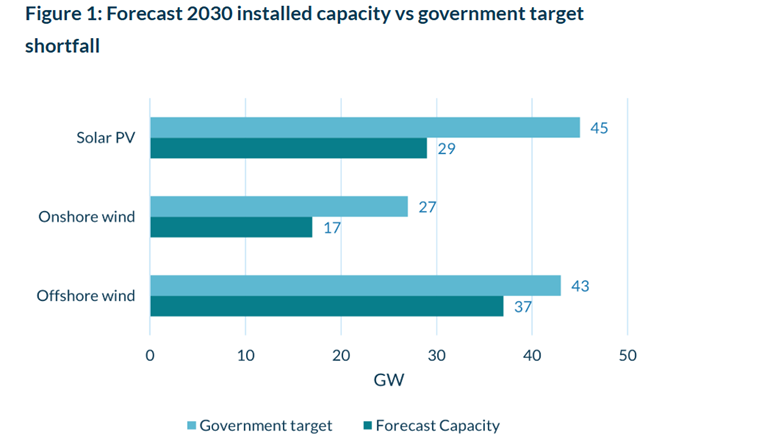
The UK government is forecast to miss it’s revised Clean Power 2030 targets for offshore, onshore and solar by a combined 32GW according to forecasts from Cornwall Insight.
The data, from Cornwall Insight’s GB Benchmark Power Curve, is projecting a shortfall in capacity, despite the government revising down its capacity targets in its Clean Power 2030 Action Plan, released in December.
With a 16GW shortfall, solar is set for the biggest underperformance, reaching 29GW compared to the 45-47GW government target.
Despite the underperformance, Cornwall Insight’s forecast still represents a 70% increase from 17GW installed today.
Onshore wind has been boosted by changes in policy, however, growth is 10GW short of the 27-29GW goal as planning issues continue to hamper progress of projects at the scale needed.
Offshore wind comes closest to the target falling just 6GW short of the 43-50GW goal. Despite cost inflation issues the sector has received consistent support through successive Contract for Difference allocation rounds.
The Clean Power 2030 Action Plan included some much-needed detail on infrastructure and grid connections, as well as investment in flexible generation technologies and storage to balance the intermittent generation, which could see an increase in renewables build-out.
However, with 2030 only five years away the impact of these reforms may not materialise quick enough to have a substantial impact on the 2030 capacity.
The growing energy demand from data centres, spurred by the government’s push to expand AI capabilities, underscores the urgency of renewable energy investment. Without sufficient capacity, the UK grid may fall back on fossil fuels, jeopardising decarbonisation goals.
Further uncertainty stems from the lack of clarity around the Review of Electricity Market Arrangements (REMA), particularly the potential move away from national wholesale pricing. These reforms would require a comprehensive overhaul of regulations, contracts, and systems, with significant commercial implications for developers.
Without clear guidance, developers are hesitant to invest, threatening the achievement of the UK’s clean power targets.
Tom Musker, modelling manager at Cornwall Insight, said: “The government’s push towards a fully decarbonised grid represents an opportunity to cement the UK’s position as a global leader in renewable energy.
“However, while setting ambitious goals for renewables is crucial, some argue that pushing too quickly could have unintended consequences, diverting resources to short-term solutions at the expense of longer-term energy security and sustainability.
“Timely investment in infrastructure, clarity on market reforms, and support for innovative project delivery are vital to unlocking the UK’s clean energy potential, ensuring we not only meet immediate clean power goals but also stay on track for our broader net zero commitments.”