


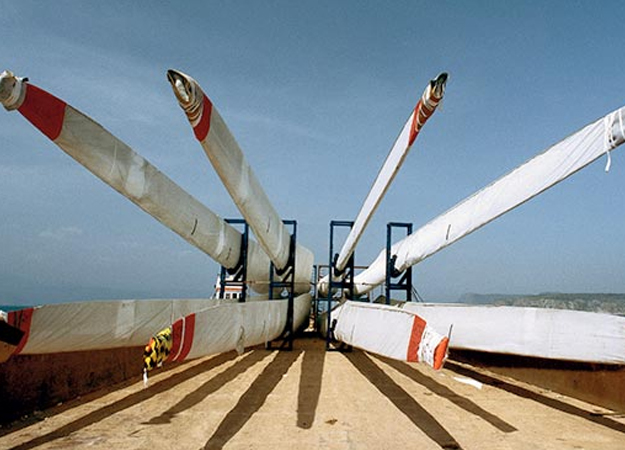
A coalition of industry and academic leaders have developed a new technology to enable circularity for thermoset composites, the material used to make wind turbine blades.
The new technology delivers the final technological step on the journey towards a fully recyclable wind turbine value chain, said the group.
A new initiative entitled CETEC (Circular Economy for Thermosets Epoxy Composites) has been established to enable the adoption of this new technology.
Within three years, CETEC is aiming to present a fully scoped solution ready for industrial adoption.
Partly funded by Innovation Fund Denmark (IFD), CETEC is spearheaded by Vestas and involves both industrial and academic leaders including Olin, the producer of Epoxy, the Danish Technological Institute (DTI) and Aarhus University.
The new technology consists of a two-step process. Firstly, thermoset composites are disassembled into fibre and epoxy.
Secondly, through a chemcycling process, the epoxy is further broken up into base components similar to virgin materials.
These materials can then be reintroduced into the manufacturing of new turbine blades, constituting a new circularity pathway for epoxy resin.
“As global commitments to a net-zero future increase, it’s absolutely crucial to ensure the wind industry can scale sustainably, which includes Vestas fulfilling our ambition to produce zero-waste turbines by 2040,” said Allan Korsgaard Poulsen, Head of Sustainability and Advanced Materials, Vestas Innovation and Concepts.
“Leveraging this new technological breakthrough in chemcycling epoxy resin, the CETEC project will be a significant milestone in Vestas’ journey towards achieving this goal, and in enabling a future where landfill is no longer required in blade decommissioning.”