


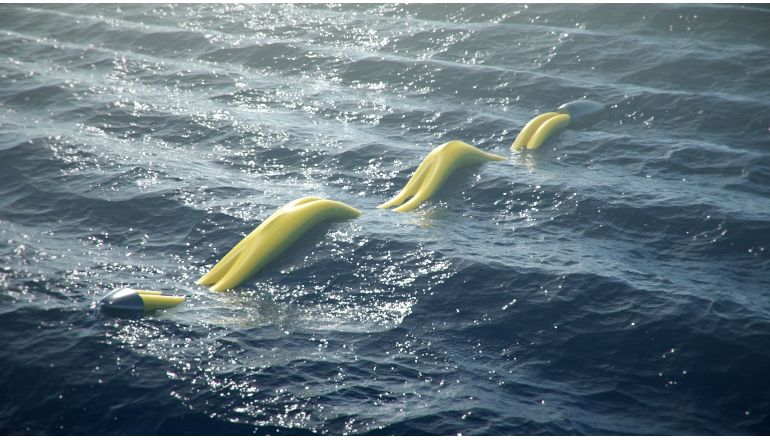
Checkmate Flexible Engineering has secured a £750,000 grant from Innovate UK to accelerate development of its Lobe-Tendon Anaconda wave energy converter, a technology designed to harness clean power from ocean waves.
The 18-month project, named Môr Neidr – Welsh for “sea snake” – builds on two years of in-house innovation and will strengthen Southwest Wales’ position as a hub for marine renewable energy.
Working with Swansea University, CGEN Engineering, the Offshore Renewable Energy Catapult and Wave Venture, the initiative will deliver new hardware, testing and research infrastructure to advance the Anaconda’s readiness for sea trials at the Welsh Marine Energy Test Area (META).
Checkmate director Paul Auston said: “This grant allows us to accelerate the Anaconda’s development and build on the innovation our team has already delivered, with a clear path toward future sea trials. It’s an exciting step forward, not just for Checkmate, but for the future of wave energy in Wales and the Celtic Sea, where we see enormous potential to deliver clean, predictable power at scale.”
The Anaconda captures wave energy through a patented bulge-tube design comprising a reinforced natural rubber outer tube and hundreds of internal tendons made from high-performance rubber.
As waves travel along the flexible structure, they generate pressure bulges that move toward a power take-off system at the end of the tube, converting energy into electricity. The internal wave speed can be adjusted to maximise power production or survivability in rough conditions.
Dr Brian Mathew, MP and member of the Marine Energy All-Party Parliamentary Group, said: “I welcome this exciting news, and I’m pleased to see innovative solutions on renewable energy like this being well supported and funded. It’s testament to the incredible expertise we have here in Wiltshire, and I will be watching on keenly in the coming months and years to see how the Anaconda develops.”
Vice Admiral Sir Adrian Johns, KCB, CBE, KStJ, DL, said: “As a former seafarer, I am fully aware of the power of the sea and the as yet untapped potential for harnessing wave energy. Having followed Anaconda’s progress over many years from the earliest scale model water tank trials, I am delighted that this truly innovative project will now be able to take the next big step towards delivering clean, renewable energy at full scale.”
Over the next 18 months, the project will combine advanced numerical modelling with tank trials, materials testing and construction of a 1:4-scale prototype section.
Checkmate said the work will refine and validate the Anaconda’s design and create new resources for the wider wave energy sector.
The company estimates that commercial deployment of wave farms in the Celtic Sea could generate predictable renewable power and contribute up to £1bn to the Welsh economy by 2050.