


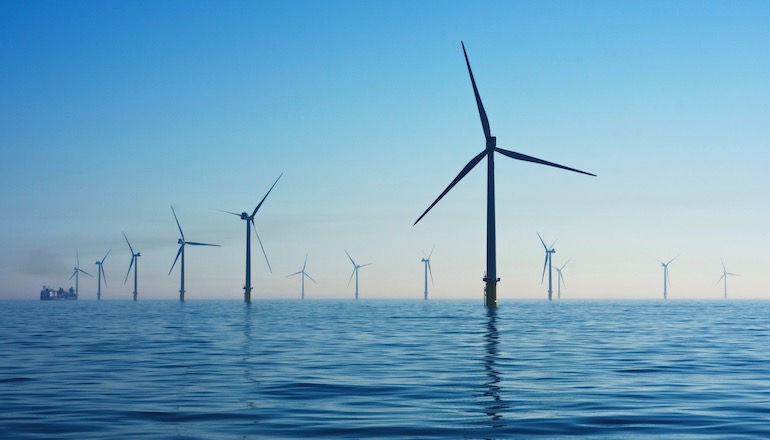
The UK’s installed wind capacity could reach 66GW by the end of this decade, providing more than half the country’s power, according to a new report from RenewableUK.
‘Powering the Future: RenewableUK’s Vision of the Transition’ predicted the UK offshore wind industry can attract £54bn (€59bn) in private investment to quadruple capacity to 40GW by 2030, providing more than a third of the UK’s electricity demand, growing to 90GW by 2050.
“Additional growth of onshore wind to 26GW by 2030 means the UK’s overall wind capacity can grow to 66GW by the end of this decade, providing more than half the UK’s power,” the report stated.
The study forecasts a six-fold expansion in wind from 22GW today to 126GW by 2050.
The installed capacity will not only meeting growing electricity demand but will also help deliver the UK’s 2050 net zero emissions target, where renewable hydrogen has a “key role” to play in the UK’s energy transition, the report stated.
Despite the short-term impacts of Covid-19 on energy use, the report anticipates low-cost renewable power will grow rapidly in the next 10 years to meet new demand from electric vehicles, low carbon heating and renewable hydrogen.
Renewables could provide over three quarters (76%) of the UK’s power needs by 2050, the report found.
The UK’s mix of high renewable energy capacity and climate change policies mean renewable hydrogen is likely to become cost-competitive in the UK faster than in other parts of the world, the study also found.
Renewable hydrogen can be used instead of gas in factories in heavy industries like steel-making as well as heating boilers in homes.
Green hydrogen from renewables can also be used to power a turbine in the same way as a combined cycle gas turbine’s operation, as well as in hydrogen fuel cells for heavy good vehicles and shipping.
RenewableUK’s report expects energy storage to grow exponentially as batteries and other forms of storage scale up to ensure our power supplies remain balanced at all times.
The report sets out a series of recommendations to government to deliver the right markets and policies to secure low-cost energy, decarbonisation and energy security.
These include holding annual auctions for contracts for large-scale renewable generators to provide low-cost power, rather than every two years, and targeting support specifically at innovative technologies which are not yet able to compete with more established power sources in these auctions.
RenewableUK chief economist Marina Valls, who wrote the report, said: “We’re entering an era of rapid technological change as we move closer towards total decarbonisation, using an even wider range of technologies such as renewable hydrogen alongside more wind, solar, battery storage and, crucially, people participating far more pro-actively in the way our modern energy system operates, making it more flexible.”