


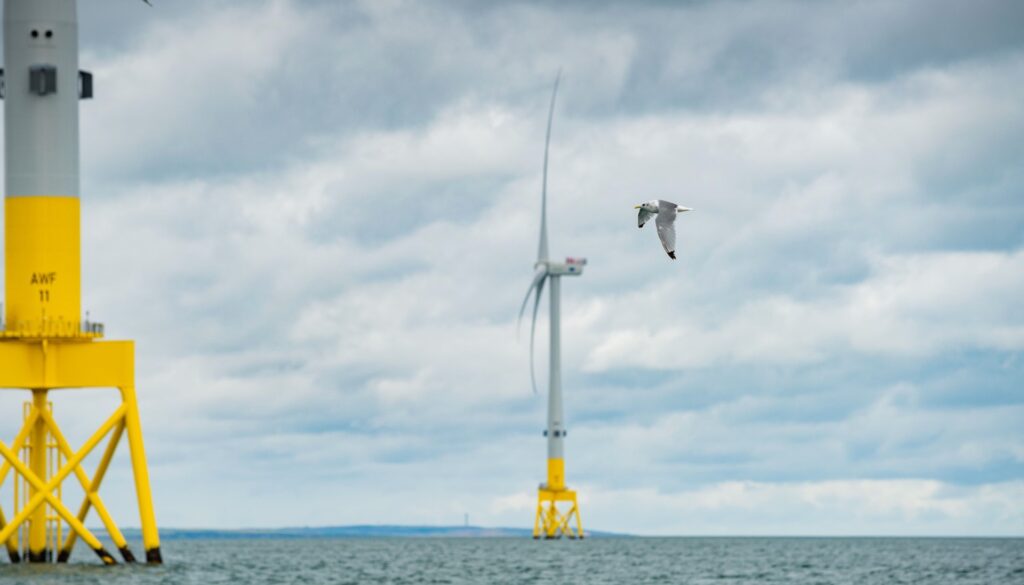
A new project tracking seabirds with AI technology has started at Vattenfall’s offshore wind farm off the coast of Aberdeen, Scotland.
Working with Norwegian AI start-up Spoor the project will trial new technology to document how seabirds interact with offshore wind turbines.
Spoor’s ground-breaking AI technology has been developed to track a bird’s 3D flight path throughout a wind farm and in the immediate vicinity of the turbine blades, providing valuable insights on bird flight patterns and behaviour, as well as potentially detecting collisions.
Being able to document avoidance behaviour accurately is vital for providing more realistic collision-risk modelling.
The information and data can then be used as a basis for establishing collision rates more directly, which will help in the planning of new offshore wind farms.
This new trial follows on from Vattenfall’s previous research project using a combination of radar and camera technology, documenting seabird flight behaviour at a larger scale around the turbines.
A stakeholder advisory panel has been formed to provide advice and input during the course of the project, including experts from the RSPB, Marine Scotland Science, NatureScot, and the Joint Nature Conservation Committee.
Progress has already been made with lots of data on seabird movements coming in and validation trials successfully completed both offshore, with an observer present, and onshore, with a drone.
The project will be presented at the Conference on Wind energy and Wildlife impacts (CWW) next week and final results are expected early next summer.
Jesper Kyed Larsen, bioscience expert at Vattenfall, said: “This exciting, collaborative project is the first of its kind to validate camera technologies for 3D tracking of seabirds in the immediate vicinity of offshore wind turbines.
“Having well understood high quality data is key to providing the evidence base we need to protect seabirds and plan the offshore wind farms of the future which are vital in the fight against climate change.”
Andrew Watts, VP partnerships and innovation at Spoor added: “We’re delighted to partner with Vattenfall and the British Trust for Ornithology on this project.
“As a DeepTech Biodiversity company it is essential to work closely with renewable energy developers, scientists, government agencies and ENGOs to speed up technology adoption and deployment, so we can make the biggest impact on protecting wildlife populations and accelerating the rollout of clean energy.”