


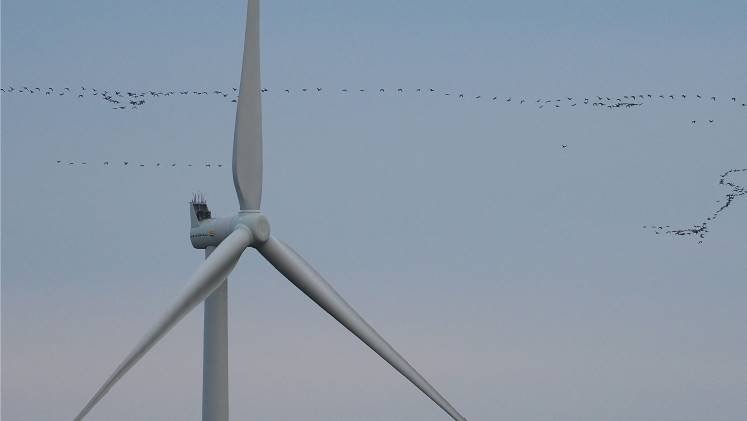
A new study with birds in Klim Wind Farm in North Jutland, Denmark has shown that birds can avoid the rotor blades of the wind turbines much better than previously assumed.
The positive result confirms a greater potential for the coexistence of nature and wind parks.
The new study, carried out for Vattenfall by three experienced consultancies in collaboration with local ornithologists, found that more than 99% of the short-billed geese and cranes flying in the area avoid the blades of the wind turbines.
The study at the Klim Wind Farm and in the Natura 2000 nature reserve Vejlerne documented the number of potential bird collisions by searching the area around the wind turbines, taking into account how many birds, foxes and similar animals may be have taken.
For short-billed geese and cranes, the evasive response during the two years of the study was calculated to be 99.9% based on a population of 20 to 30,000 geese and several hundred cranes.
Neither short-billed geese nor cranes were found where it could have been established with certainty that they had died as a result of a collision with the wind turbines.
To be on the safe side, the study assumed that any birds or remains of birds found under the wind turbines could have been involved in a collision.
By comparing the potential number of birds that collided with the birds registered in the area, a so-called evasive response was calculated using the internationally recognized band model.
The study was carried out for Vattenfall by three recognized consulting firms, including local professional ornithologists.
Klim Wind Farm is located in the immediate vicinity of the international Natura 2000 bird sanctuary Vejlerne.
Every day thousands of birds leave their roosts in the Vejlerne area and fly to the nearby fields to find food, with many flying through the wind farm.
Vattenfall Environment & Sustainability’s bioscience lead Jesper Kyed Larsen said: “The area is an important natural area and quite unusual, as 20 to 30,000 short-billed geese and several hundred cranes sleep here.
Thousands of birds fly past the wind farm both morning and evening during the winter time, which is why it is so gratifying to learn that the birds fly around or over the wind turbines on such a large scale.
Hardly any of them collided with the wind turbines, and the number of those who did is significantly lower than previously assumed.”