


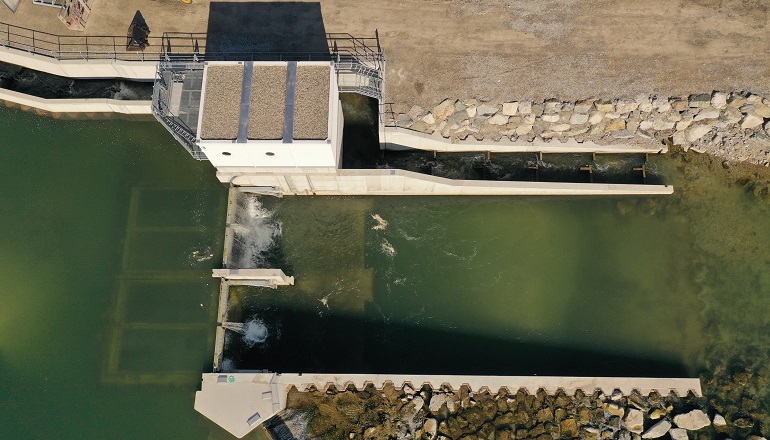
A hydropower plant designed to reduce impact on aquatic life in rivers has gone on stream in Germany.
In the plant, designed by Technical University Munich, a turbine is concealed in a shaft in the riverbed, allowing fish to pass freely over the power plant on their migration downstream.
Hydropower plants can contribute to climate mitigation efforts, because they produce renewable energy, but they also cause problems for the natural environment.
In a conventional run-of-river power plant, the water is diverted to a power house in order to drive the turbine. The strong currents that occur can drag fish towards the plant turbine and grids, where they are at risk of being injured or killed.
A team at TU Munich’s hydraulic and water resources engineering department decided to develop a hydropower plant that would have a significantly lower impact on the natural environment.
With the new plant design, there is no need to divert the course of the river. Instead, a shaft housing the turbine and the generator is dug into the riverbed upstream of a weir. The water flows into the shaft, drives the turbine, and is then returned to the river under the weir. A smaller part of the water flows over the shaft and past the weir.
The engineers have managed to control the current so that the power plant can efficiently produce electricity while minimising the formation of vortices in the shaft.
Numerous tests on a prototype have shown that most fish are able to swim safely over the shaft. What is more, two openings in the weir allow them to migrate downstream unharmed, while upstream migration is facilitated by an ordinary fish pass.
A spin-off, Hydroshaft, headed by the concept’s creator Albert Sepp has acquired rights of use and licenses the technology to power plant operators. A total of twelve plants are currently in the planning stage in Germany.
As well as protecting the fish in the river, the shaft power plant allows debris and driftwood to pass more freely downstream. The transit and deposition of this “bedload” is important for spawning grounds, for example. A type of grate called a rack, which lies on the shaft, keeps this material away from the turbine.
The bedload is then regularly pushed downstream by the plant. For this purpose a gate is opened in the weir. This adjustable system also allows water to be released when the river floods.
“If we want to protect the climate while also preserving nature, we need to develop technologies capable of skillfully balancing these two goals,” said project leader Peter Rutschmann.
“We know that nature is always impacted to some degree by a hydropower plant.”
Compliance with extremely strict environmental standards meant that permission was granted to build the first shaft power plant in a nature reserve (Natura 2000 area).
The fish migration routes on the river Loisach in Bavaria were even improved by the construction.
The power plant was built by a municipal utility company at an existing ramp which until then had been difficult for fish to pass through. There was no need to build a new weir for the project.
The shaft power plant is suitable for different sizes of river as well as different fall heights.
Depending on demand, electricity can be generated in multiple adjacent shafts.