


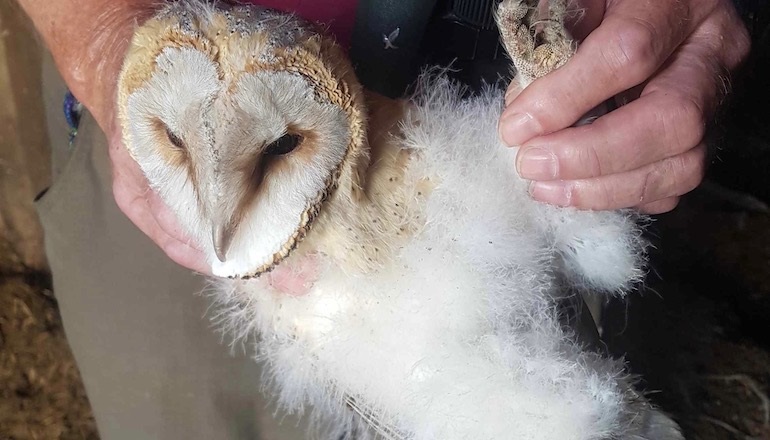
Three pairs of nesting barn owls have successfully bred at the Crystal Rig wind farm in the Scottish Borders.
In early June, a total tally of 12 hatchlings and nine eggs were recorded across four sites, but in July it was discovered that one pair produced a clutch of infertile eggs. Three pairs successfully reared their young, with eight chicks still present at their nest sites in mid-July.
Planning conditions attached to the wind farm’s consent required an ornithological monitoring plan, which specified the requirement for artificial nesting baskets for long-eared owls.
The boxes were installed to mitigate the loss of nesting habitat for the species as large areas of forestry, where long-eared owls live, were felled to allow for wind farm construction.
Through the on-going monitoring work, no long-eared owls were found. However, barn owls, which live in open habitats, have been observed using the wind farm area and breeding in nearby outbuildings.
Natural Power then installed three barn owl boxes in various locations around the wind farm to promote the growth of the local barn owl population.
Licensed members of the Lothian & Borders Raptor Study Group (L&BRSG ) were invited to help with catching and ringing the chicks at the last site visit.
Natural Power environmental consultant Pawel Plonczkier said: “The provision of artificial nest sites is a crucial part of any conservation initiative for barn owls, due to modern landscapes offering few nesting opportunities for this species. We subsequently monitored how many boxes were occupied and recorded the breeding success.”
Of the four pairs breeding at Crystal Rig this year, one pair occupied one of the new boxes, two pairs were resident in a dilapidated farm building and a shed, and one pair nested in an old tree nest box which was installed by Natural Power in 2014.
He added: “Supporting the barn owls by providing artificial nest sites is vital not only for breeding birds but also for non-breeders and fledged youngsters that would use boxes for hiding and roosting – helping to increase their chance of survival.”